New media uses digital technology and the internet to deliver content through websites, apps,
streaming services and social platforms. It is interactive, on-demand and highly targeted.
What is New Media?
New media refers to digital forms of media that rely on computers, mobile devices and the
internet. Examples include websites, social media platforms, video and music streaming
services, podcasts, apps and online games.
Unlike traditional media, new media is usually interactive and
on-demand. Audiences can choose when and how they access content, react
by liking, sharing or commenting, and even create their own media.
Key points you must remember
New media uses digital technology and the internet (e.g. websites, apps, streaming).
It is often interactive and lets audiences respond, share and create content.
It can be highly targeted using user data and analytics.
It is usually cheaper to distribute than traditional media and can reach global audiences.
New Media at a Glance
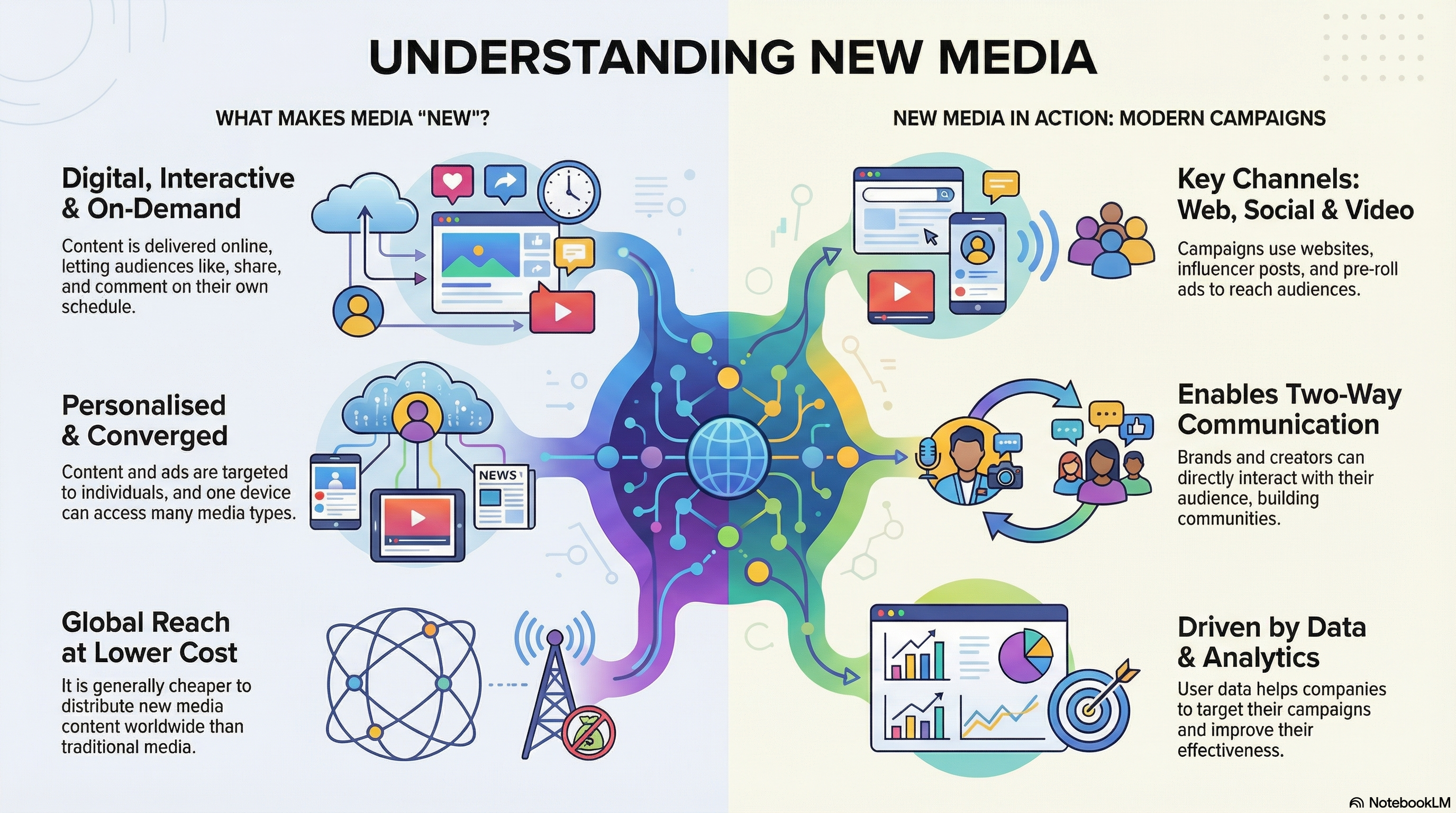
This infographic explains what makes media "new" and how digital technologies change campaigns.
What Makes Media "New"?
Digital, interactive and connected technologies.
Digital delivery: content accessed through the internet and digital devices.
Interactivity: audiences can like, share, comment, vote and participate.
On-demand: users choose when and where to access content (catch-up, streaming).
Personalisation: content and adverts can be targeted to individuals.
Convergence: one device can access TV, games, web, social and messaging.
Exam link: compare new media with traditional media in terms of reach and interactivity.
Digital · Interactive · On-demand
New Media in Campaigns
How advertisers and creators use new media channels.
Websites & microsites: hubs for detailed information and calls-to-action.
Social media: posts, stories, shorts and influencer partnerships.
Video platforms: pre‑roll ads, sponsored content and branded channels.
Apps & games: branded apps, advergames and in‑game advertising.
Cross‑platform campaigns: consistent message across web, social and offline media.
Exam tip: say how new media allows two-way communication and data collection.
Use these games to test your understanding of new media platforms, how they differ from
traditional media and how they are used in modern campaigns.
Media industry
Sector Sorter
Drag-and-drop game sorting traditional vs new media, products and job roles.
Perfect for Section A media industry questions.
MCQsSectorsJob roles
Distribution
Distribution Dash
Match scenarios to the best platforms and file formats for mobile, web
and print, plus physical vs digital distribution.
MCQsFormatsPlatforms
Mixed exam
Escape Room: R093
Escape each room by answering questions on sectors, roles, planning, legal
issues, codes, distribution and more.
MixedWhole specChallenge mode
Exam Practice – New Media (AI Marker)
Write your answers in the boxes below, then click Build & Copy AI Marking Prompt. Choose an AI tool and paste the prompt to get examiner-style marking and feedback.
Q1. State one example of new media. (1 mark)
Technique: Give a clear, specific example such as "a social media
platform" or "a video streaming service" rather than just saying "the internet".
Q2. Explain one way that audiences can interact with new media. (2 marks)
Technique: Describe the interaction (e.g. commenting, sharing,
creating content) and explain the impact (e.g. builds communities, spreads messages).
Example structure: "One way audiences can interact is… This means that…"
Q3. Describe one advantage of using social media instead of posters to promote a new mobile game. (3 marks)
Technique: Make a clear point about targeting, interactivity or cost,
then develop it with detail and impact on the audience.
Q4. Explain two ways that data and analytics can help a company improve its new media campaign. (4 marks)
Technique: Give two separate points. For each one, state how data is used,
then explain how this improves the campaign's effectiveness.
Q5. A charity is planning a campaign to raise awareness of cyberbullying. Discuss the advantages
and disadvantages of using new media instead of traditional media for this campaign. (9 marks)
Technique: Compare new media and traditional media. Include reach,
targeting, interactivity, credibility and cost, then give a justified conclusion.
Paragraph 1–2: Advantages of new media (targeting, interactivity, sharing, cost).
Paragraph 3: Limitations of new media (digital divide, reliability, distraction).
Paragraph 4: Brief comparison with traditional media (TV, radio, posters).
Final paragraph: Conclusion – recommend the best approach for the charity and justify it.
Level 2 → Level 3 Boost (Q5)
As you type, this will spot what's missing for top-band answers.
Start typing your answer to see tailored targets.
Open an AI tool:
Can You Now…?
Give at least three examples of new media.
Explain how new media lets audiences interact with content.
Compare how new media and traditional media can be used in a campaign.