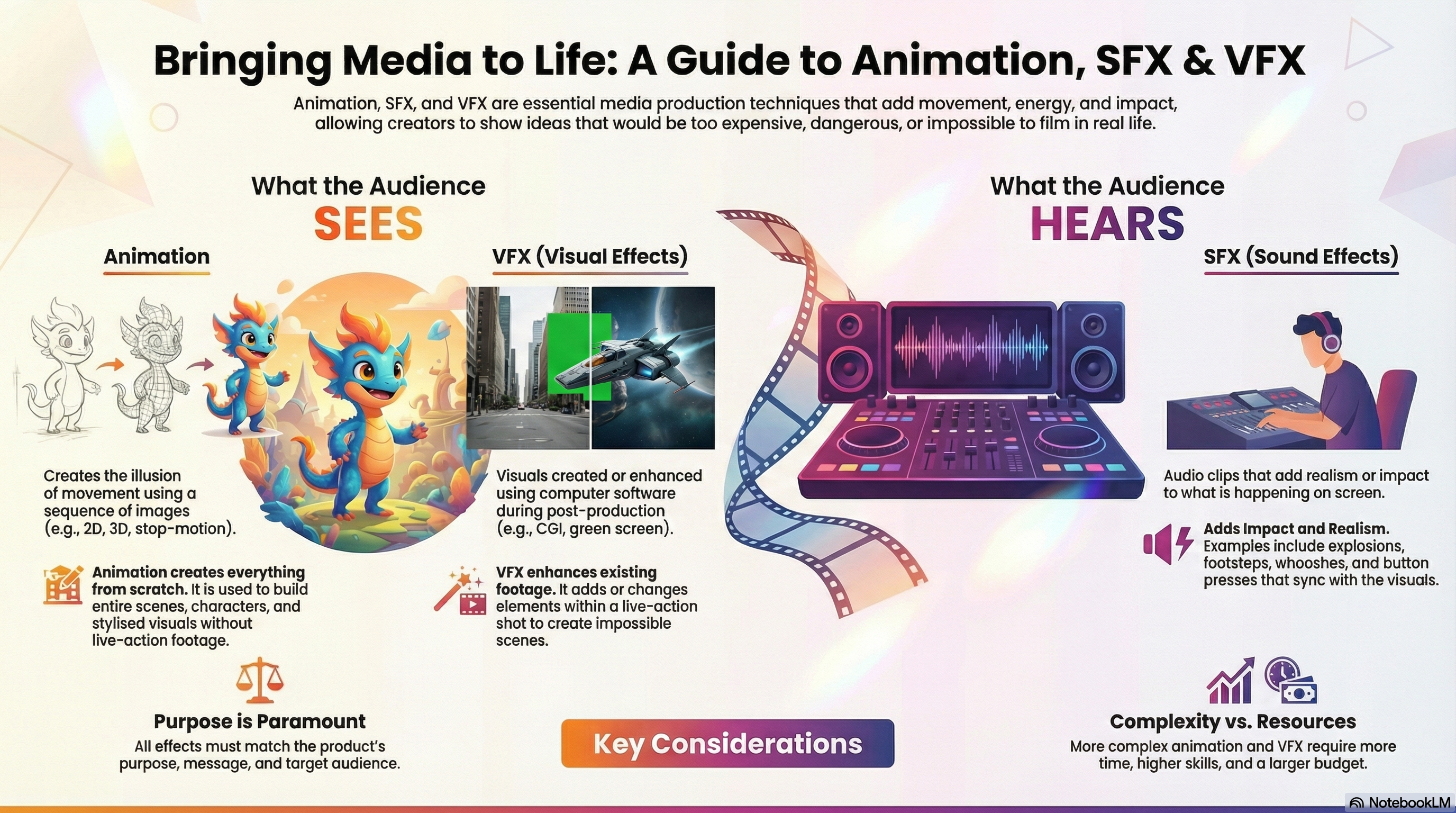
Animation, sound effects (SFX) and visual effects (VFX) are used to add movement, energy
and impact to media products. They help show ideas that would be expensive, dangerous or
impossible to film in real life.
What are Animation, SFX & VFX?
Animation is a sequence of images played quickly to create the illusion of
movement. It can be 2D, 3D, stop-motion or motion graphics, and is used in adverts, title
sequences, explainer videos, games and apps.
SFX (sound effects) are audio clips that add realism or impact, such as
footsteps, explosions, button presses or whooshes. They support the on-screen action and
help focus the audience's attention.
VFX (visual effects) are visuals created or enhanced using computer
software. These include green-screen compositing, CGI elements, particle effects and
digital filters added in post-production.
Key points you must remember
Animation is used to show movement, explain ideas and create stylised visuals.
SFX and VFX work together with video and music to build atmosphere and impact.
VFX can be used to create scenes that are too dangerous, expensive or impossible to film.
All effects must still match the purpose, message and
target audience of the product.
More complex animation and VFX usually require more time, skill and budget.
Animation, SFX & VFX at a Glance
Use this infographic to remember the difference between animation, sound effects (SFX) and visual effects (VFX),
and when each is used.
Use these games to practise how animation, sound effects and visual effects help create
meaning, mood and impact in different media products.
All topics
iMedia Genius
The flagship exam-style quiz covering every R093 question type: MCQs, short answers,
binary questions, bonus rounds and timed scoring – including questions on animation,
SFX and VFX.
Exam-styleAll R093 contentMixed difficulty
Product design
Media Codes Challenge
Identify technical, symbolic and written codes in media clips and explain how camera,
lighting, colour, SFX and VFX work together to create meaning and mood.
ExplainCodes & conventionsCamera · SFX · VFX
Pre-production
Script Surgeon
Improve weak scripts by adding clearer stage directions, SFX cues and camera notes so
the final animation or video will work smoothly in production.
9 markersScriptsImprovements
Moving image
Animation, SFX & VFX Challenge
Fast-paced arcade quiz – decide if each example uses CGI, SFX, VFX, stop-motion or motion graphics and explain why.
Arcade quizSFX & VFXCGI vs practical
Exam Practice – Animation, SFX & VFX (AI Marker)
Write your answers in the boxes below, then click Build & Copy AI Marking Prompt. Choose an AI tool and paste the prompt to get examiner-style marking and feedback.
Q1. State one reason why a game trailer might use animation instead of live action footage. (1 mark)
Technique: Give a short, clear reason such as showing fantasy content,
saving costs or matching the game's visual style.
Q2. Explain how SFX can make an action sequence more engaging for the audience. (2 marks)
Technique: Make one point about what SFX add (e.g. impact, realism)
and then explain the effect on the audience.
Example structure: "Sound effects make the sequence more engaging by…
This means the audience…"
Q3. Describe one way VFX could be used in a film trailer for a superhero movie. (3 marks)
Technique: Describe a specific VFX technique (e.g. flying, energy blasts,
city destruction) and then develop your answer by linking to the purpose and audience.
Q4. Explain two ways animation can help explain a complex process in an educational video. (4 marks)
Technique: Give two separate points. For each one, link the animation
technique (e.g. diagrams, labels, step-by-step motion) to how it helps the audience
understand the content.
Q5. A streaming service is producing a short animated ident (logo animation) to appear
before its original shows. Discuss how animation, SFX and VFX could be combined
effectively to promote the brand. (9 marks)
Technique: Cover how animation, SFX and VFX each support the brand's
identity, tone and target audience. Explain the impact on the audience and reach a
justified conclusion.
Paragraph 1: How animation style (2D/3D, motion, timing) reflects the brand.
Paragraph 2: How SFX support the on-screen action and logo reveal.
Paragraph 3: How VFX (glows, particles, transitions) add polish and impact.
Final paragraph: Conclusion – which elements are most important and why.
Level 2 → Level 3 Boost (Q5)
As you type, this will spot what's missing for top-band answers.
Start typing your answer to see tailored targets.
Open an AI tool:
Can You Now…?
Explain the difference between animation, SFX and VFX.
Give examples of when you would use animation instead of live action.
Describe how SFX and VFX can change how an audience feels about a product.