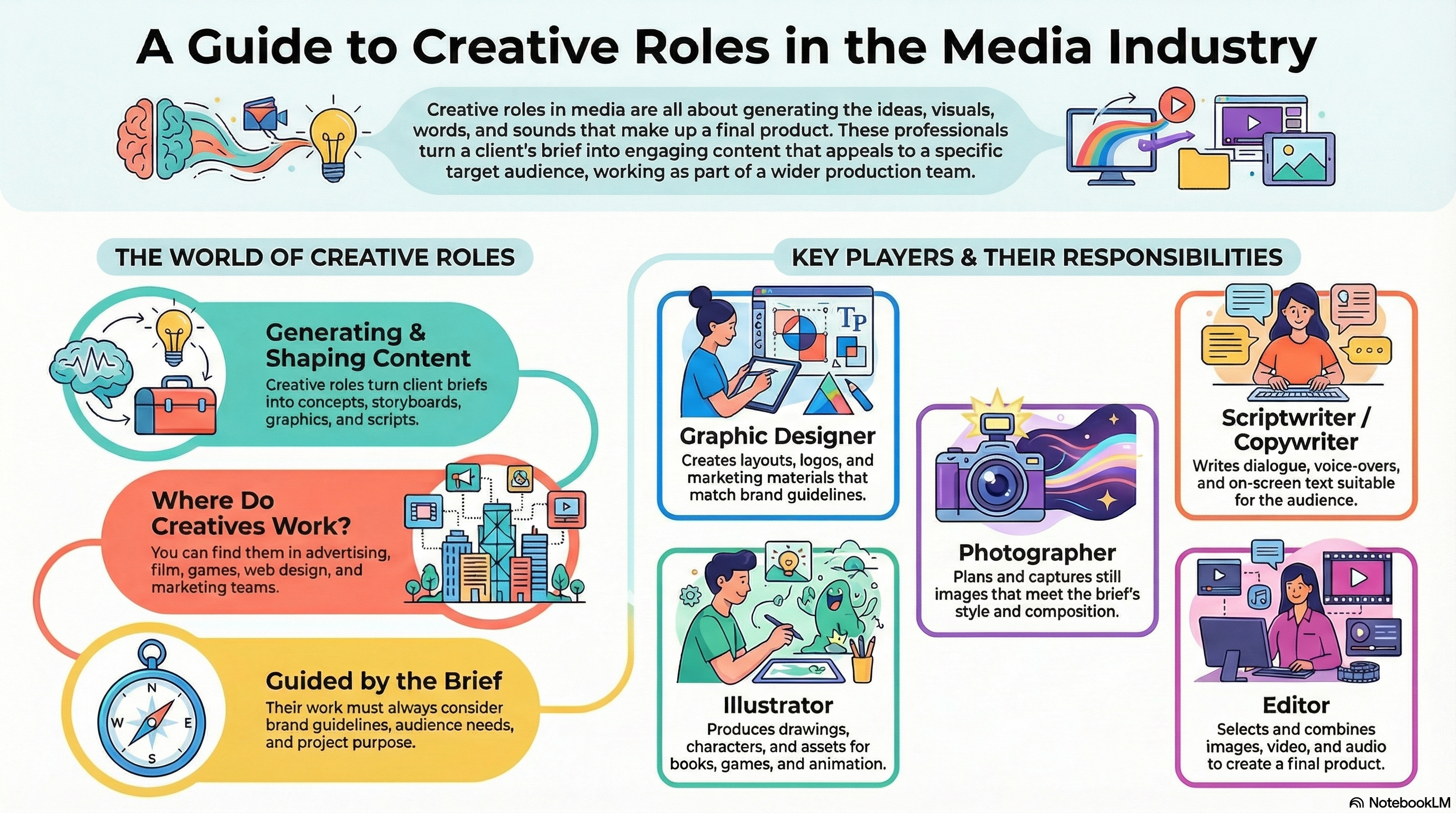
Creative job roles focus on ideas, visuals, words and sound. They turn a client brief into
concepts, storyboards, scripts, page layouts, graphics and audio that will appeal to the
target audience.
What are Creative Job Roles?
Creative job roles are responsible for generating and shaping content for
media products. These roles include graphic designers, illustrators, photographers,
scriptwriters, copywriters, editors, animators and UI designers.
They work closely with clients, producers and technical staff to make sure the final product
is visually appealing, on-brand and suitable for the purpose and
target audience.
Key points you must remember
Creative roles focus on ideas, visuals, words, sound and user experience.
Each role has specific responsibilities and required skills.
Creative staff often respond to client briefs and pitch concepts or treatments.
They must consider brand guidelines, audience needs and legal/ethical issues.
Creative work is usually part of a wider production team and workflow.
Creative Job Roles at a Glance
These infographics summarise where creative job roles fit into the media industry and the
responsibilities you can write about in the exam.
Where Creative Roles Work
Key places you will find creative job roles in media projects.
Advertising agencies: copywriters, designers and art directors creating campaigns.
Film & TV production: scriptwriters, storyboard artists, editors and title designers.
Game studios: concept artists, character designers, level designers and UI designers.
Web & app design teams: UX/UI designers, graphic designers and content designers.
In‑house marketing teams: social media designers, content creators and brand designers.
Freelancers: self‑employed creatives working for multiple clients on different projects.
Sectors · Teams · Workplaces
Key Creative Roles & Responsibilities
Job titles, what they actually do and exam phrases you can use.
Graphic designer: creates layouts, logos, icons and marketing materials that match brand guidelines.
Illustrator: produces drawings, characters and assets for books, games, web and animation.
Photographer: plans and captures still images that meet the brief (composition, lighting, style).
Videographer / camera operator: records moving image footage using appropriate framing and movement.
Scriptwriter / copywriter: writes dialogue, voice‑over and on‑screen text suitable for the audience.
Editor: selects and combines images, video and audio to create a final product that flows well.
Use these games to practise matching job roles to responsibilities, sectors and workflows.
Focus on who does what in a production team.
Job roles
Guess Who? Job Roles
Read the clues, think about responsibilities and choose the correct production role to
build your multiplier and sharpen your score.
MCQsJob rolesResponsibilities
Media industry
Sector Sorter
Drag-and-drop game sorting traditional vs new media, products and job roles.
Perfect for Section A media industry questions.
MCQsSectorsJob roles
All topics
iMedia Genius
The flagship exam-style quiz covering every R093 question type: MCQs, short answers,
binary questions, bonus rounds and timed scoring.
Exam-styleAll R093 contentMixed difficulty
Exam Practice – Creative Job Roles (AI Marker)
Write your answers in the boxes below, then click Build & Copy AI Marking Prompt. Choose an AI tool and paste the prompt to get examiner-style marking and feedback.
Q1. State one responsibility of a graphic designer in a media project. (1 mark)
Technique: Give one clear responsibility, such as creating page layouts,
designing logos or preparing artwork for print or web.
Q2. Explain one reason why a client might use a copywriter for a website project. (2 marks)
Technique: Make one point about the value of professional writing
(e.g. persuasive text, clear information) and then explain the impact on the audience.
Example structure: "A copywriter helps by… This means that…"
Q3. Describe one difference between the role of a photographer and the role of a videographer. (3 marks)
Technique: Identify a clear difference (e.g. still images vs moving image,
equipment used, types of output) and then develop your answer with an example.
Q4. Explain two skills a scriptwriter needs when writing for a TV advert. (4 marks)
Technique: Give two separate skills (e.g. concise writing, understanding
of audience, timing to fit the slot). For each, explain how it helps the advert meet its purpose.
Q5. A production company is planning a promotional video for a new theme park ride.
Discuss the creative job roles that would be involved in planning and producing the video,
and explain how they would work together. (9 marks)
Technique: Cover several creative roles (e.g. scriptwriter, graphic designer,
storyboard artist, photographer/videographer, editor) and explain their contributions.
Finish with a clear conclusion about how teamwork helps meet the client brief.
Paragraph 1–2: Describe key creative roles and their responsibilities.
Paragraph 3: Explain how they collaborate and share ideas during production.
Paragraph 4: Link their work to the brief, target audience and brand.
Final paragraph: Conclusion – why these roles are essential to a successful product.
Level 2 → Level 3 Boost (Q5)
As you type, this will spot what's missing for top-band answers.
Start typing your answer to see tailored targets.
Open an AI tool:
Can You Now…?
Name at least three creative job roles and describe what they do.
Explain the difference between creative, technical and senior roles.
Suggest which creative roles would be needed for different media projects.