Client requirements explain what the client wants the product to do, who it is for and how it
should look, sound and feel. A clear understanding of the brief is essential for a successful project.
What are Client Requirements?
Client requirements describe what the client expects from the media product.
They usually include the purpose, target audience,
content, style, timescales and any
constraints such as budget, legal issues or technical limits.
Requirements may be given in different forms, such as written briefs, scripts, emails,
formal documents or meetings. You must be able to read a brief and pick out the key points.
Key points you must remember
Client requirements link directly to the purpose and audience of the product.
They can be functional (what it must do) and aesthetic (how it should look/feel).
Constraints include budget, time, resources, legal and technical limitations.
Success criteria describe how the client will judge whether the product is effective.
Responding accurately to requirements is vital in exam questions and coursework.
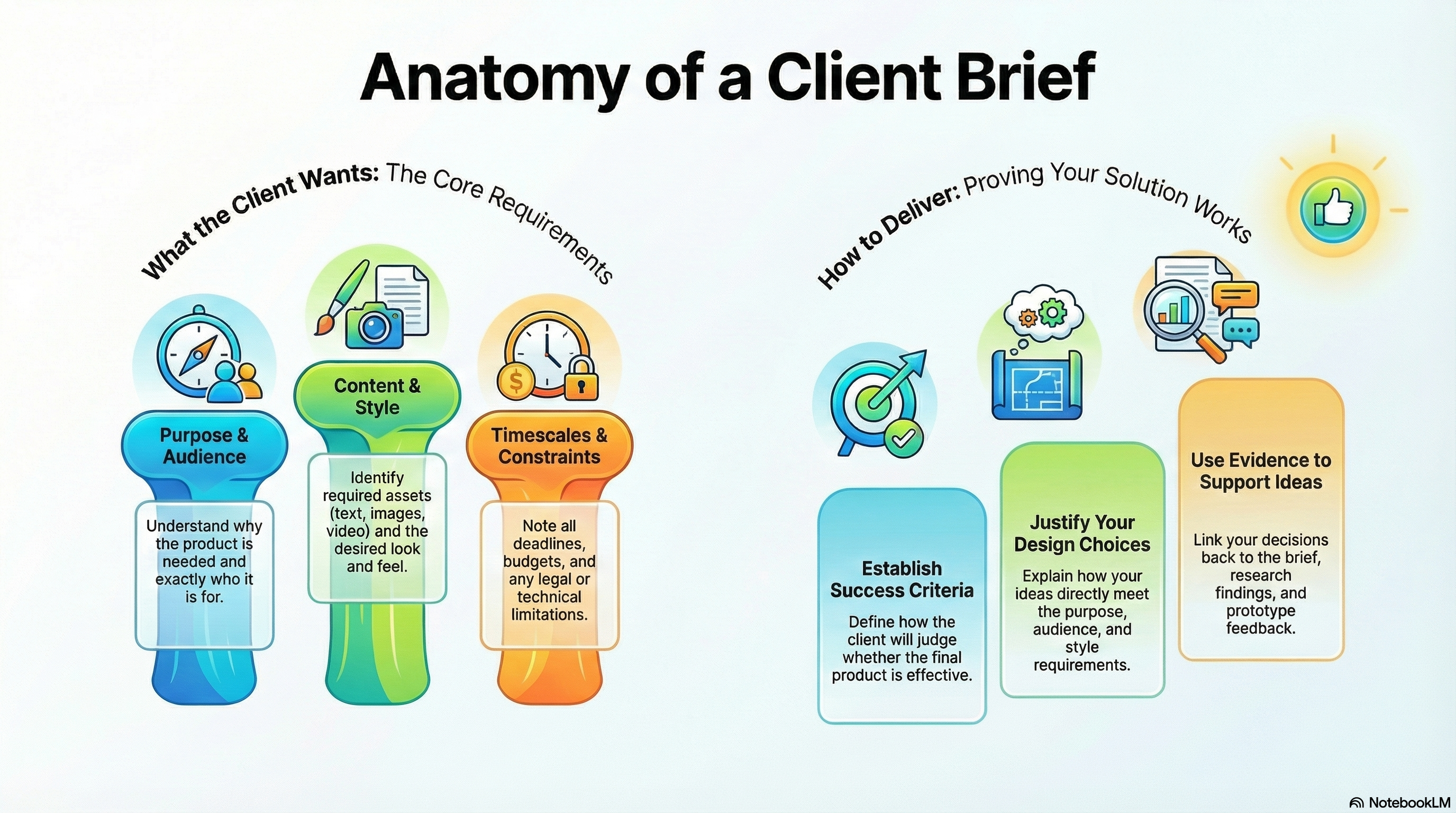
Client Requirements at a Glance
Use this infographic to break down a client brief into clear requirements you can lift into exam answers.
Types of Client Requirements
What the brief is really telling you to do.
Purpose & audience: why the product is needed and who it is for.
Content: text, images, audio, video, features and functions that must be included.
Style: look and feel, brand colours, fonts, tone of voice, level of formality.
Timescales: key dates, deadlines, milestone reviews and launch dates.
Constraints: budget, legal and ethical issues, technical limitations, resources.
Exam link: pick out and quote requirements directly from the brief to support your answer.
What · Who · How
Success Criteria & Responding to the Client
How to show that your ideas meet the client's needs.
Success criteria: how the client will judge if the product is effective.
Meeting requirements: explain how your ideas match purpose, audience, content and style.
Negotiating: suggest realistic changes if timescales, budget or resources are tight.
Evidence: link back to the brief, research findings and prototype feedback.
Exam structure: state requirement → explain idea → justify why it works.
Exam tip: use the phrase "This meets the client requirement because…" followed by a clear reason.
Use these games to practise spotting key information in client briefs, linking requirements
to audiences and choosing suitable products and formats.
Product design
Client Brief Detective
Race the clock to find key information in client briefs: purpose, audience,
timescales, ethos and constraints.
Short answersClient briefConstraints
Product design
Audience Matcher
Use segmentation categories such as age, income, lifestyle and interests to
match media products to the correct audience.
MCQsSegmentationTargeting
All topics
iMedia Genius
The flagship exam-style quiz covering every R093 question type: MCQs, short answers,
binary questions, bonus rounds and timed scoring.
Exam-styleAll R093 contentMixed difficulty
Client briefs
Client Brief Builder
Identify brief types and separate requirements from constraints in real exam-style scenarios.
Arcade quizBrief typesReqs vs constraints
Exam Practice – Client Requirements (AI Marker)
Write your answers in the boxes below, then click Build & Copy AI Marking Prompt. Choose an AI tool and paste the prompt to get examiner-style marking and feedback.
Q1. State one type of information that might be included in a client brief. (1 mark)
Technique: Give one clear example such as target audience, purpose, deadline
or required format.
Q2. Explain one reason why it is important to identify the target audience in a client brief. (2 marks)
Technique: Make one point about how audience affects content, style or platform,
then explain the impact on the success of the product.
Example structure: "Identifying the target audience is important because… This means that…"
Q3. Describe one way a designer could clarify unclear requirements with a client. (3 marks)
Technique: Describe a specific action (e.g. follow-up meeting, email with questions,
showing mood boards or sketches) and then develop your answer by explaining how this helps avoid mistakes.
Q4. Explain two constraints that might affect the design of a social media campaign for a small business. (4 marks)
Technique: Give two separate constraints (e.g. limited budget, short timescale,
limited staff, platform rules). For each, explain how it affects the choices made by the designer.
Q5. A client has asked for a website to promote a new fitness app. The brief includes purpose,
audience, key features, timescale and budget. Discuss how a designer should use this information
when planning the website and explain why it is important to follow the client requirements. (9 marks)
Technique: Refer directly to elements of the brief (purpose, audience, features,
timescale, budget). Explain how each one influences design decisions and production planning, then
reach a justified conclusion about why meeting requirements matters.
Paragraph 1: Use of purpose and audience to plan style, tone and content.
Paragraph 2: Use of key features to decide pages, navigation and media assets.
Paragraph 3: Use of timescale and budget to plan realistic production and testing.
Final paragraph: Conclusion – consequences of not following requirements (unhappy client, wasted time, product not fit for purpose).
Level 2 → Level 3 Boost (Q5)
As you type, this will spot what's missing for top-band answers.
Start typing your answer to see tailored targets.
Open an AI tool:
Can You Now…?
List key types of information found in client requirements.
Explain how requirements link to audience, purpose and constraints.
Use a client brief to suggest suitable media products and features.