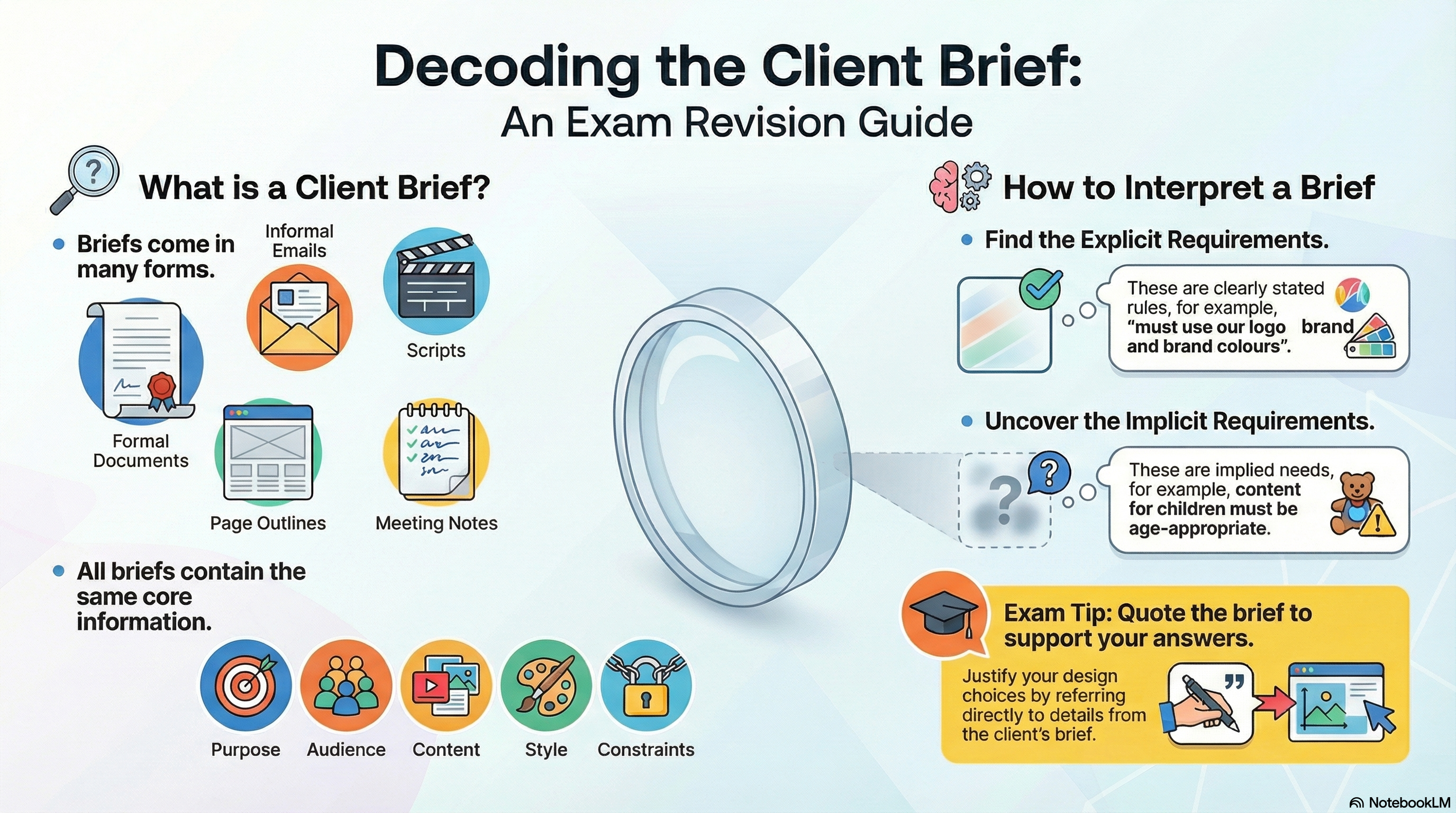
Client requirements can be given in many formats: formal written briefs, informal emails,
scripts, page outlines, proposals and meetings. You must be able to pick out the same key
information, whichever format is used.
What are Client Brief Formats?
Client brief formats are the different ways that a client can explain what
they want. The content is similar (purpose, audience, content, style, timescales, constraints)
but the way it is presented changes.
You might see a formal document with headings, a more informal email, a script-style outline,
a page mock-up, a treatment or notes from a meeting. In the exam, you must read the brief
carefully and extract the important details, whatever the format.
Key points you must remember
Common formats include formal briefs, emails, scripts, page outlines, treatments and meeting notes.
All formats still include core requirements: purpose, audience, content, style and constraints.
You must identify explicit requirements (stated clearly) and implicit ones (implied).
Understanding the format helps you know where to look for key information.
In exam questions, always quote or refer to details from the brief to support your answers.
Client Brief Formats at a Glance
Different formats contain similar information. This infographic helps you spot it quickly in the exam.
Common Brief Formats
Different ways the client can explain what they want.
Formal written brief: structured document with headings and bullet points.
Informal email: less structured, but still contains purpose, audience and constraints.
Script or page outline: shows scenes, panels or page layout instead of paragraphs.
Treatment / proposal: longer document pitching style and approach in more detail.
Meeting notes: actions, decisions and requirements captured from a discussion.
Exam link: whichever format you see, hunt for purpose, audience, content, style and timescales.
Formats · Structure · Clues
Explicit vs Implicit Requirements
Reading between the lines of the brief.
Explicit requirements: clearly stated (e.g. "must use our logo and brand colours").
Implicit requirements: implied by the context (e.g. suitable for children, safe, age-appropriate).
Format clues: headings, subject lines, dialogue and stage directions reveal extra details.
Constraints: hidden in phrases such as "limited budget" or "tight deadline".
Exam structure: identify → quote → explain how it affects your ideas.
Exam tip: write "This is an implicit requirement because…" and justify your interpretation.
Explicit · Implicit · Constraints
Formal Brief vs Commission-Style Brief
Understanding the difference between a formal client brief and a
commission-style brief is essential for exam questions about planning,
interpretation and risk.
Formal Client Brief
Structured, detailed and clearly documented.
Format: Written document with headings and sections.
Detail: Clear purpose, target audience, content, style and constraints.
Clarity: Requirements are explicit and easy to quote in exams.
Risk: Lower risk of misunderstanding between client and producer.
Used when: Larger projects, higher budgets or professional commissions.
Exam tip: Ideal for identifying explicit requirements.
Structured · Explicit · Low Risk
Commission-Style Brief
Informal instructions given verbally or digitally.
Format: Email, phone call, meeting or short message.
Detail: Often incomplete or loosely defined.
Clarity: Some requirements are implicit and must be inferred.
Risk: Higher chance of misinterpretation or missing constraints.
Used when: Smaller jobs, fast turnaround or ongoing client relationships.
Exam tip: Explain how a producer would clarify or confirm details.
Use these games to practise reading different types of client briefs and turning them
into strong exam answers with clear explanations and justifications.
Product design
Client Brief Detective
Race the clock to find key information in client briefs: purpose, audience,
timescales, ethos and constraints.
Short answersClient briefConstraints
Mixed exam
Explain It! 2-Mark Engine
Practise perfect 2-mark answers for advantages, disadvantages and differences
with instant feedback on structure and detail.
2 markersPEE structureTargeted practice
9‑mark trainer
9‑Mark Ninja
Train step-by-step to build top band (Level 3) 9‑mark answers: structure your points,
develop explanations and justify decisions clearly.
9 markersStructureExam technique
Client briefs
Client Brief Builder
Identify brief types and separate requirements from constraints in real exam-style scenarios.
Arcade quizBrief typesReqs vs constraints
Exam Practice – Client Brief Formats (AI Marker)
Write your answers in the boxes below, then click Build & Copy AI Marking Prompt. Choose an AI tool and paste the prompt to get examiner-style marking and feedback.
Q1. State one format that a client brief could be presented in. (1 mark)
Technique: Give a simple, clear example such as a formal document,
email, script outline or meeting notes.
Q2. Explain one advantage of using a formal written brief instead of an informal phone call. (2 marks)
Technique: Make one point about clarity, record-keeping or avoiding
misunderstandings, then explain the impact on the project.
Example structure: "A written brief is useful because… This means that…"
Q3. Describe one problem that might occur if a designer misinterprets an email brief. (3 marks)
Technique: Describe a specific problem (e.g. wrong audience, wrong style,
missed deadline) and then develop your answer by explaining the consequences for the client
and the product.
Q4. Explain two reasons why meeting notes are useful after a client discussion. (4 marks)
Technique: Give two separate reasons (e.g. record of agreed changes,
reminder of deadlines, evidence if there is a dispute). For each, explain how it helps
keep the project on track.
Q5. A client has provided a storyboard and an email to explain their ideas for a short
promotional video. Discuss how a media designer should use both formats to understand
the client's requirements and plan the production. (9 marks)
Technique: Refer to what each format is good at (storyboard for visual
flow and shots, email for extra details, constraints and tone). Explain how combining
both helps the designer understand the brief fully and avoid mistakes. Finish with a
justified conclusion.
Paragraph 1: Role of the storyboard in showing sequence, shots and key visuals.
Paragraph 2: Role of the email in clarifying purpose, audience, timescales and constraints.
Paragraph 3: How the designer cross-references both formats to check understanding.
Final paragraph: Conclusion – why using both formats leads to a more accurate product.
Level 2 → Level 3 Boost (Q5)
As you type, this will spot what's missing for top-band answers.
Start typing your answer to see tailored targets.
Open an AI tool:
Can You Now…?
List different formats a client brief might use.
Explain the strengths and weaknesses of different brief formats.
Use information from a brief to plan suitable media products and responses.