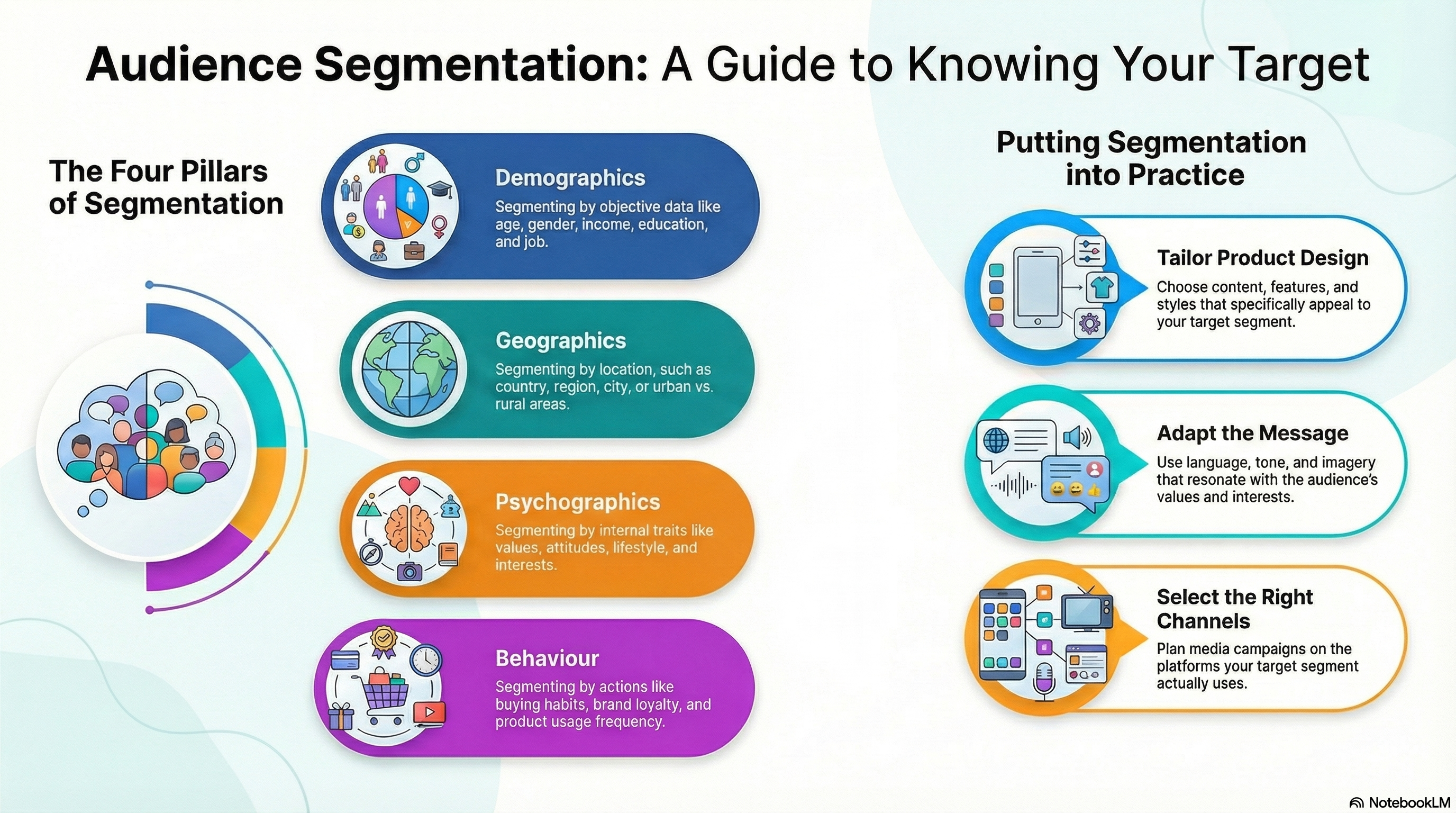
Audience segmentation means splitting a large audience into smaller groups based on factors like
age, gender, income, location, interests and lifestyle. This helps media products and campaigns
hit the right people in the right way.
What is Audience Segmentation?
Audience segmentation is the process of dividing potential customers or users into
groups that share similar characteristics. These characteristics can include
demographics (age, gender, income), geographics (where they live),
psychographics (values, attitudes, lifestyle) and behaviour
(buying habits, loyalty, usage patterns).
Understanding segments helps producers design media products and campaigns that are more relevant,
appealing and effective for specific groups rather than trying to target "everyone" at once.
Key points you must remember
Segmentation categories include demographics, geographics, psychographics and behaviour.
Products can be aimed at mass markets or niche audiences.
Targeting a clear segment can improve engagement and make marketing more efficient.
Different segments may prefer different platforms, styles and content types.
Exam questions often ask you to match a product or idea to a suitable audience segment.
Audience Segmentation at a Glance
These infographics summarise how audiences are divided into segments and how to use this in exam answers.
Types of Audience Segments
The main segmentation categories you must remember.
Demographics: age, gender, income, education, family status, job.
Geographics: country, region, city, climate, urban vs rural.
Use these games to practise matching media products to segments, choosing platforms and
sharpening your explanation skills for exam questions.
Product design
Audience Matcher
Use segmentation categories such as age, income, lifestyle and interests to
match media products to the correct audience.
MCQsSegmentationTargeting
Mixed exam
Explain It! 2-Mark Engine
Practise perfect 2-mark answers for advantages, disadvantages and differences
with instant feedback on structure and detail.
2 markersPEE structureTargeted practice
All topics
iMedia Genius
The flagship exam-style quiz covering every R093 question type: MCQs, short answers,
binary questions, bonus rounds and timed scoring.
Exam-styleAll R093 contentMixed difficulty
Audiences
Audience Segmentation Simulator
Match campaigns to demographic, psychographic and behavioural segments – practise exam-style audience reasoning.
Arcade quizAudienceSegmentation
Exam Practice – Audience Segmentation (AI Marker)
Write your answers in the boxes below, then click Build & Copy AI Marking Prompt. Choose an AI tool and paste the prompt to get examiner-style marking and feedback.
Q1. State one way an audience can be segmented. (1 mark)
Technique: Give one clear category such as age, gender, income,
location or interests.
Q2. Explain one reason why a games company might target a niche audience instead of a mass audience. (2 marks)
Technique: Make one clear point (e.g. more focused marketing, stronger
brand loyalty) and then explain the impact on the success of the product.
Example structure: "Targeting a niche is useful because… This means that…"
Q3. Describe one way a streaming service could use audience segmentation to recommend shows. (3 marks)
Technique: Describe a specific method (e.g. tracking viewing history or
interests) and then develop your answer by explaining how this helps match content to users.
Q4. Explain two reasons why it is important to identify the age range of the target audience when designing a mobile game. (4 marks)
Technique: Give two separate reasons (e.g. difficulty level, content
suitability, PEGI rating, controls). For each, explain how it affects design decisions.
Q5. A company is launching a new eco-friendly sports drink. Discuss how audience segmentation
could be used to plan a media campaign for the product, and explain how targeting different
segments might change the choice of platforms and messages. (9 marks)
Technique: Refer to different segments (e.g. teens who play sport,
young professionals, fitness enthusiasts). Explain how each segment might prefer different
platforms, visuals and messages. Finish with a justified conclusion about which segments
are most important.
Paragraph 1: Identify possible segments using demographics and lifestyle.
Paragraph 2: Explain how platforms (social media, posters, influencers) might change by segment.
Paragraph 3: Explain how messages (health benefits, performance, eco values) might be emphasised differently.
Final paragraph: Conclusion – which segment(s) to prioritise and why.
Level 2 → Level 3 Boost (Q5)
As you type, this will spot what's missing for top-band answers.
Start typing your answer to see tailored targets.
Open an AI tool:
Can You Now…?
List key audience segmentation categories.
Explain the difference between mass and niche audiences.
Suggest suitable segments and platforms for different media products.