Audience research helps producers understand who their audience is, what they like and how they
behave. Good research leads to better ideas, safer decisions and more successful products.
What is Audience Research?
Audience research is the process of collecting information about existing or
potential audiences. It helps media producers understand their needs,
preferences, opinions and behaviour so that
products and campaigns can be designed more effectively.
Research can be carried out using different methods, such as surveys, interviews, focus groups,
observation, test screenings, analytics or social media insights. Each method has strengths and
weaknesses in terms of cost, depth of information and reliability.
Key points you must remember
Audience research supports decisions about content, style, platforms and marketing.
It can be primary (you collect it yourself) or secondary (using existing data).
Quantitative research gives numerical data; qualitative research gives detailed opinions.
Reliable research uses a suitable sample size and unbiased questions.
Exam questions often ask you to choose or justify suitable research methods for a scenario.
Audience Research at a Glance
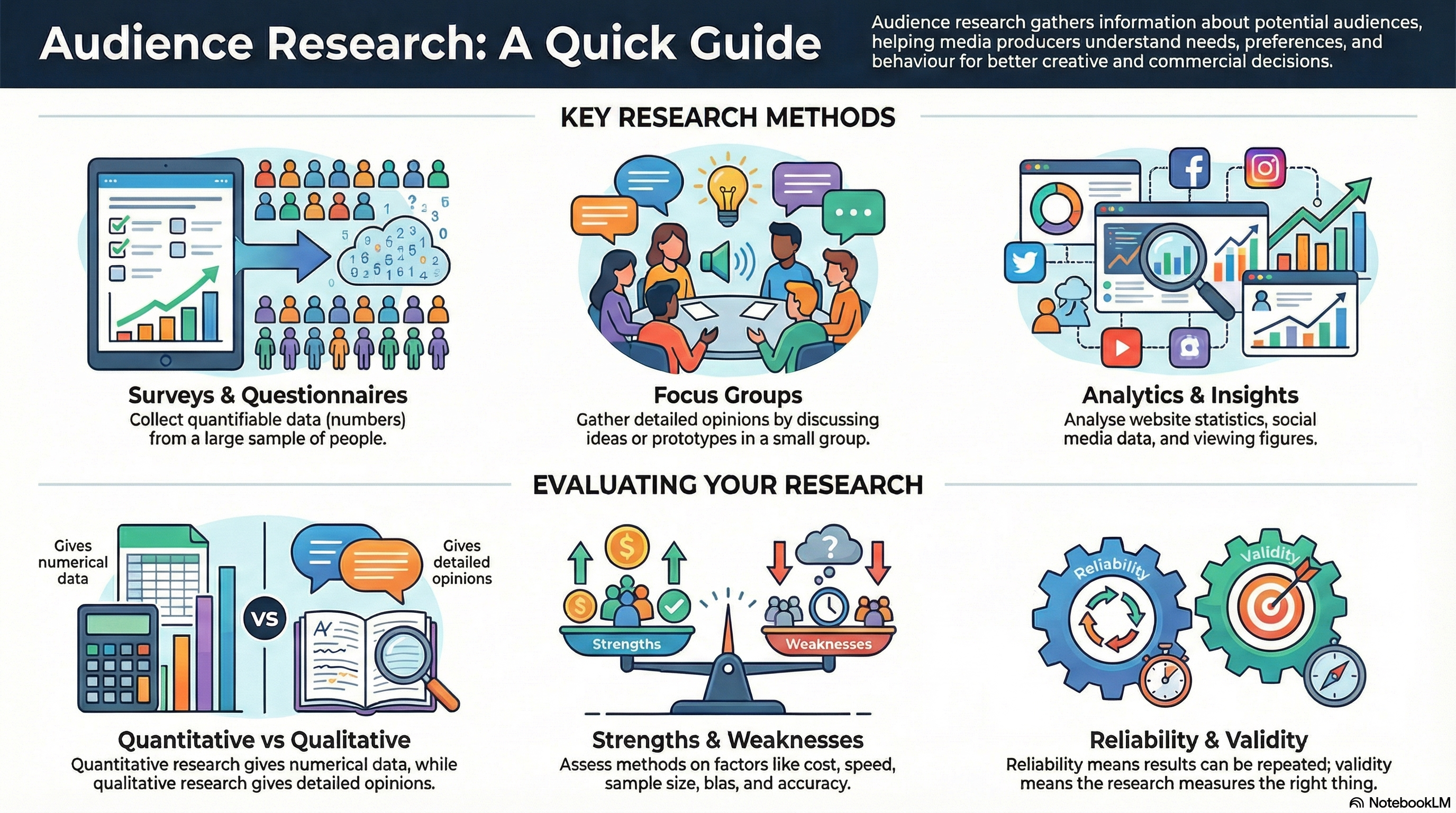
This infographic shows the main audience research methods and how to discuss their strengths and weaknesses.
Common Audience Research Methods
Ways to find out what audiences think, feel and do.
Surveys / questionnaires: collect quantifiable data from larger samples.
Interviews: in-depth, one-to-one conversations for detailed opinions.
Focus groups: small group discussions about ideas, prototypes or trailers.
Observation / user testing: watch people using a product to spot problems.
Analytics & insights: website stats, social media data, viewing figures.
Exam link: select the most suitable method(s) for the scenario given.
Methods · Data · Insights
Strengths, Weaknesses & Exam Phrases
How to evaluate research methods instead of just naming them.
Strengths: accuracy, depth, large sample size, low cost, speed or realism.
Weaknesses: bias, small sample, time-consuming, expensive, limited detail.
Quantitative vs qualitative: numbers/statistics vs detailed opinions.
Reliability: whether results would be similar if the research was repeated.
Validity: whether the research actually measures what you need it to.
Exam tip: write "This method is appropriate because…" and link to the scenario's audience and budget.
Use these games to practise picking suitable research methods, interpreting findings and
turning them into clear explanations and justifications for exam questions.
Mega game · Research methods
Research Methods Adventure
Work through staged challenges on primary and secondary research, quantitative vs qualitative
data and reliability before a project begins.
Mega gamePrimary & secondaryReliability
Mixed exam
Explain It! 2-Mark Engine
Practise perfect 2-mark answers for advantages, disadvantages and differences
with instant feedback on structure and detail.
2 markersPEE structureTargeted practice
All topics
iMedia Genius
The flagship exam-style quiz covering every R093 question type: MCQs, short answers,
binary questions, bonus rounds and timed scoring.
Exam-styleAll R093 contentMixed difficulty
Exam Practice – Audience Research (AI Marker)
Write your answers in the boxes below, then click Build & Copy AI Marking Prompt. Choose an AI tool and paste the prompt to get examiner-style marking and feedback.
Q1. State one method of audience research. (1 mark)
Technique: Give one clear method such as a survey, interview,
focus group or questionnaire.
Q2. Explain one reason why a games company might use a questionnaire before releasing a new game. (2 marks)
Technique: Make one point about feedback on features, preferences or price,
then explain how this helps improve the game or marketing.
Example structure: "A questionnaire helps because… This means that…"
Q3. Describe one advantage and one disadvantage of using focus groups for audience research. (3 marks)
Technique: Give a paired answer. Advantage: detailed opinions, group discussion.
Disadvantage: small sample, not fully representative. Develop each point briefly.
Q4. Explain two reasons why a large, varied sample is important when carrying out audience research. (4 marks)
Technique: Give two separate reasons (e.g. more reliable results,
better representation of the target audience). For each, explain the impact on the final product.
Q5. A production company is planning a new social media campaign for a streaming service.
Discuss which research methods they could use to find out more about their audience, and
explain how the results would help them design an effective campaign. (9 marks)
Technique: Refer to different methods (e.g. online surveys, polls, analytics,
focus groups, A/B testing). Explain what each method would reveal and how it would influence
decisions about content, scheduling and platforms. Finish with a justified conclusion.
Paragraph 1: Outline 2–3 suitable research methods and what data they provide.
Paragraph 2: Explain how this data influences design choices (content, style, timing).
Paragraph 3: Explain how research reduces risk and improves campaign effectiveness.
Final paragraph: Conclusion – which methods are most useful and why.
Level 2 → Level 3 Boost (Q5)
As you type, this will spot what's missing for top-band answers.
Start typing your answer to see tailored targets.
Open an AI tool:
Can You Now…?
List common audience research methods and say what they are used for.
Explain the difference between quantitative and qualitative audience research.
Choose suitable research methods for different media projects and justify your choices.