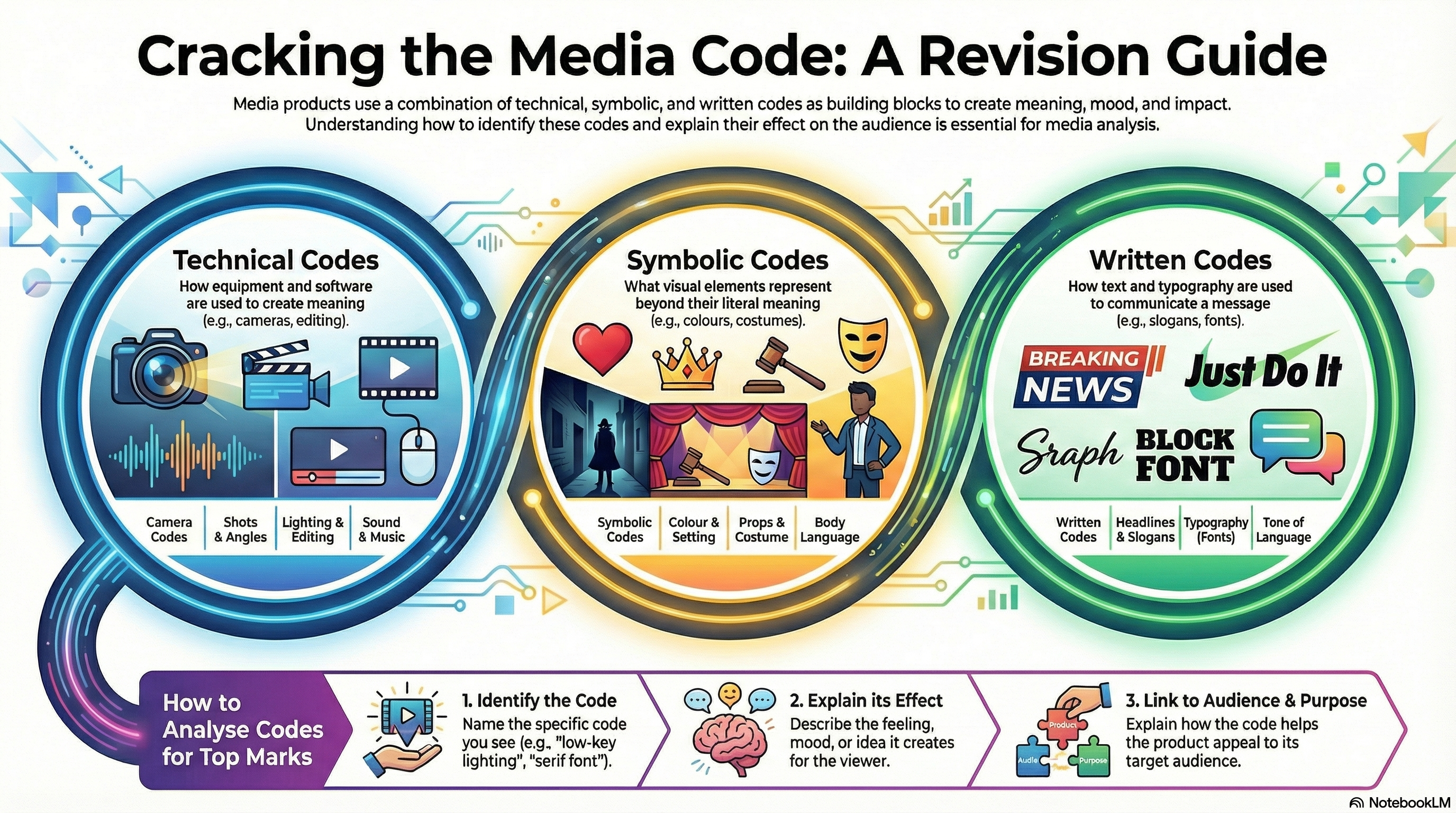
Media codes are the building blocks of meaning in media products. By understanding technical,
symbolic and written codes, you can explain how producers create mood, represent characters
and target specific audiences.
What Are Media Codes?
Media codes are the techniques used to construct media products and communicate
meaning to an audience. They are divided into technical, symbolic
and written codes, and they appear in everything from posters and trailers to
websites and games.
In the exam you must be able to identify codes in a product and
explain how they affect the audience or support the product's purpose.
Types of Media Codes You Must Know
Technical codes – created by equipment and software:
Camera shots and angles (close-up, long shot, high angle, low angle)
Lighting (high-key, low-key, coloured gels)
Editing (fast or slow pace, transitions, montage)
Audio (music, sound effects, voiceover, dialogue)
Symbolic codes – what visual elements represent:
Colour (e.g. red = danger or passion, blue = calm or trust, gold = luxury)
Body language and facial expression (open posture, smiling, frowning)
Costume and props (business suit, sportswear, expensive car, gaming headset)
Setting (office, city at night, park, school, home)
Written codes – how text is used:
Headlines, slogans and taglines
Captions and on-screen text
Typography (serif vs sans serif vs script fonts)
Tone of language (formal, informal, persuasive, humorous)
Key Points You Must Remember
Producers combine different codes to create a specific mood or impression.
You should always link codes to their effect on the audience.
Exam questions often ask you to explain how codes create meaning or support a purpose.
Use media vocabulary such as close-up, low-key lighting, serif font, slogan in your answers.
For higher marks, link codes to the target audience and purpose of the product.
Media Codes at a Glance
This infographic breaks down technical, symbolic and written codes and how to explain their effects.
Technical Codes
Created by equipment, software and production techniques.
Camera: shot types, angles, movement (e.g. close-up, high angle, tracking shot).
Lighting: high-key, low-key, coloured gels, spotlights, natural vs artificial light.
Editing: pace, transitions, cutting on action, montages and parallel editing.
Sound: music, sound effects, dialogue, silence and voiceover.
Digital techniques: filters, grading, overlays, visual effects and motion graphics.
Exam link: name the code and explain how it affects the audience's feelings or understanding.
Camera · Lighting · Editing
Symbolic & Written Codes
What elements represent and how text communicates meaning.
Symbolic codes: costume, setting, props, colour and body language that represent ideas.
Written codes: headlines, captions, dialogue, slogans and on-screen text.
Connotation: what elements suggest or imply beyond their literal meaning.
Genre: how codes signal horror, comedy, sci-fi, action, etc.
Representation: how codes portray people, places, issues or groups.
Exam tip: use the structure "The use of [code] suggests…" followed by impact on audience and purpose.
For flash cards and mind maps, use our NotebookLM for this topic. It includes
quick-fire revision prompts on technical, symbolic and written codes and how
they create meaning.
Use these games to practise spotting technical, symbolic and written codes, explaining
their effects and linking them to audience and purpose.
Product design
Media Codes Challenge
Identify technical, symbolic and written codes in media examples and explain how
they create meaning, impact and engagement.
ExplainCodes & conventionsCamera · Audio · Colour
Product design
Colour Critic
Compare logos, posters and magazine covers to choose the strongest use of colour and typography
for the target audience.
MCQsColourTypography
Product design
Audience Matcher
Match media products and design choices to the correct audience using age, lifestyle and interests.
Great for linking codes to target audience.
MCQsSegmentationTargeting
Mixed exam
Exam Styles Showdown
Compare different student answers and choose the one that would score the most marks.
Ideal for practising strong explanations of media codes.
Exam-styleCommand wordsModel answers
Exam Practice – Understanding Media Codes (AI Marker)
Write your answers in the boxes below, then click Build & Copy AI Marking Prompt. Choose an AI tool and paste the prompt to get examiner-style marking and feedback.
Q1. State one type of media code used in a film trailer. (1 mark)
Technique: Name one type clearly, such as a technical code (camera shot),
symbolic code (colour) or written code (slogan).
Q2. Explain one way written codes can influence the meaning of a magazine cover. (2 marks)
Technique: Make one clear point (e.g. a bold headline grabs attention or a slogan
creates a certain tone), then explain how this affects the audience's interpretation.
Example structure: "Written codes influence meaning because… This means the audience…"
Q3. Describe one way colour can be used as a symbolic code in a film poster. (3 marks)
Technique: Identify a colour choice, explain what it symbolises and then explain
how this affects the audience's expectations or feelings about the film.
Q4. Explain two ways technical codes could be used in a sportswear advert to make the product look exciting. (4 marks)
Technique: Give two separate points, such as fast-paced editing or low-angle shots,
and for each one explain how it makes the product or athletes seem more powerful, energetic or
aspirational.
Q5. A new gaming headset company wants an advert that feels exciting and futuristic.
Discuss how media codes (technical, symbolic and written) can be used to make the product appealing
to the target audience. Provide justified recommendations. (9 marks)
Technique: Refer to all three types of codes. For example, technical codes such as
neon lighting and fast cuts, symbolic codes like colour and costume, and written codes such as slogans
and typography. Explain how each choice appeals to gamers, then finish with a clear conclusion about
which codes are most effective and why.
Paragraph 1: Technical codes – camera, lighting, editing and their impact.
Paragraph 2: Symbolic codes – colour, body language, setting and what they suggest.
Paragraph 3: Written codes – headlines, slogans and font choices.
Final paragraph: Conclusion – which combination of codes will work best and why.
Level 2 → Level 3 Boost (Q5)
As you type, this will spot what's missing for top-band answers.
Start typing your answer to see tailored targets.
Open an AI tool:
Can You Now…?
Define technical, symbolic and written codes and give clear examples of each.
Explain how specific codes create meaning and affect the audience.
Apply your knowledge of media codes to exam-style scenarios and justify your choices.