Intellectual Property Rights (IPR) protect creative work such as images, music, video,
software and writing. Media producers must respect these rights and use content legally, or they risk
fines, takedown notices and damage to their reputation.
What Are Intellectual Property Rights?
Intellectual property (IP) is any original creative work that someone has produced.
Intellectual Property Rights (IPR) are the legal rights that give creators control over
how their work is used.
Copyright – protects original creative works (music, video, images, text, software).
Trademarks – protect brand names, logos and slogans.
Patents – protect new inventions or technical ideas (less common in GCSE media projects).
Licences – give permission to use IP under agreed conditions.
Why IPR Matters in Media
Producers often need to use existing assets – photos, fonts, music, icons.
They must check that content is legal to use and correctly credited.
Exam questions can ask you to identify legal risks and recommend solutions.
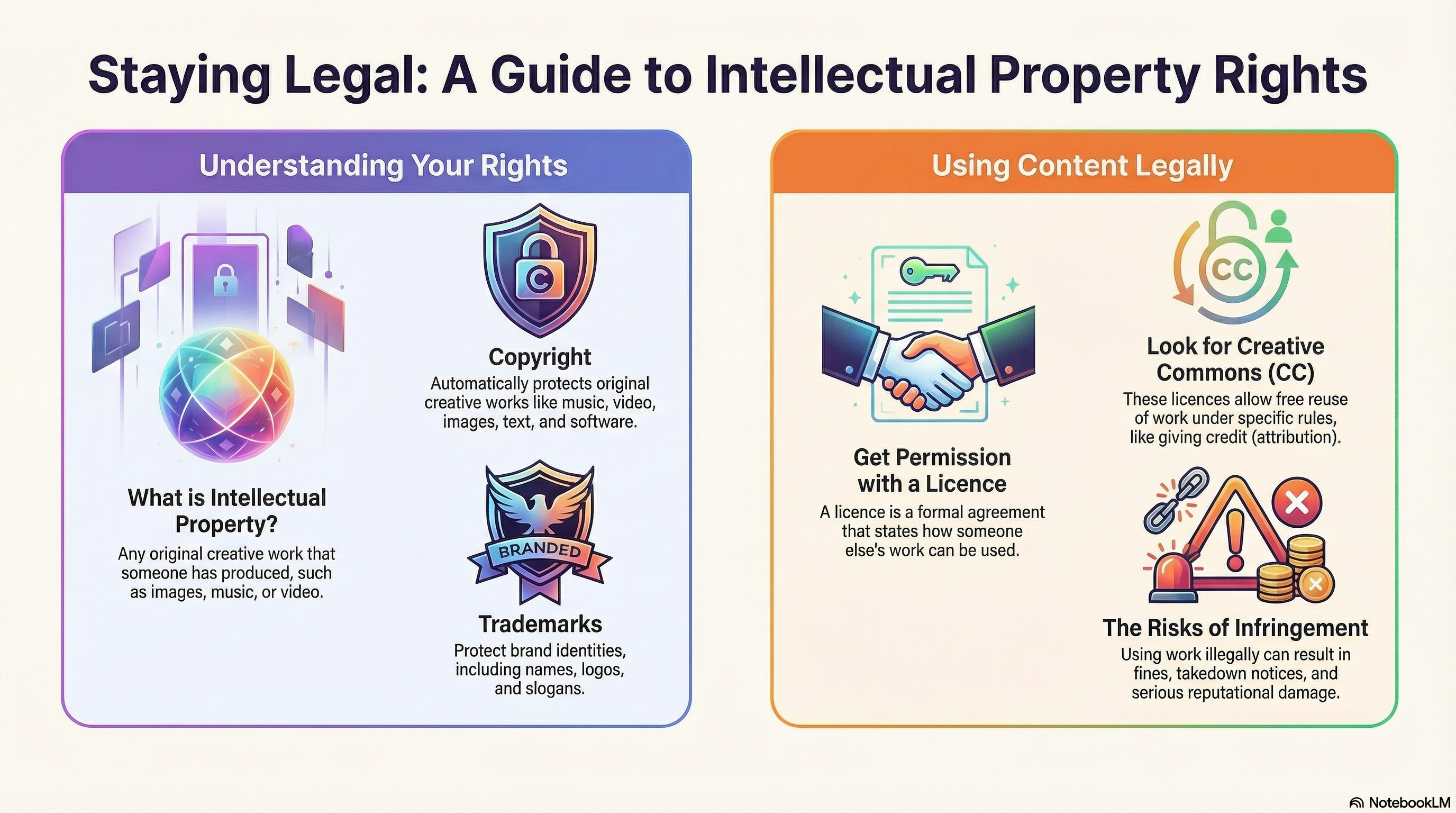
Intellectual Property Rights at a Glance
This infographic summarises key IPR types and how media producers use other people's work legally.
Types of Intellectual Property
Legal rights that protect creative and original work.
Copyright: protects original music, video, images, writing and software.
Trademarks: protect brand names, logos and slogans.
Patents: protect new inventions and technical processes.
Design rights: protect the look and shape of products.
Moral rights: right to be named as the creator and object to harmful changes.
Exam link: identify which IPR applies in a scenario and what it protects.
Copyright · Trademarks · Patents
Using Content Legally
How producers avoid infringement and respect IPR in projects.
Licensing: getting permission to use copyrighted work under agreed conditions.
Creative Commons: licences that allow reuse with rules (e.g. attribution, non-commercial).
Royalty-free vs rights-managed: different ways to pay for stock assets.
Infringement: using content without permission or outside the licence terms.
Consequences: takedown notices, fines, legal action and reputational damage.
Exam tip: when planning a product, state how you will source or create assets legally.
Licences · Permissions · Consequences
Copyright and Infringement
Copyright automatically applies when someone creates an original work. The creator (or
their employer/client) usually owns the copyright and decides how the work may be used.
Copyright Covers
Images and photographs.
Music and sound effects.
Video clips and animations.
Text (articles, scripts, website copy).
Logos, artwork and some types of graphics and designs.
Copyright Infringement
Using someone's work without permission or a valid licence.
Sharing or distributing unlicensed copies (e.g. pirated films, music or software).
Editing or adapting a work and pretending it is your own.
Consequences of Infringement
Takedown requests or removal of content from platforms.
Fines, legal action or claims for compensation.
Damage to the company's or creator's reputation.
Licences and Creative Commons
A licence is a formal agreement that says how someone else's work can be used. Some licences
must be paid for; others are free but still have rules.
Types of Licence
Royalty-free – pay once (or sometimes free) and then use under certain conditions.
Rights-managed – licence for a specific use (time period, region, media type).
Site-specific licences – e.g. stock image sites with their own usage rules.
Creative Commons (CC)
Creative Commons provides standard licences creators can apply to their work so others know
how they can use it. Examples include:
CC BY – can use and adapt the work, but must give credit.
CC BY-SA – must credit and share new work under the same licence.
CC BY-NC – can use non-commercially only, with credit.
CC BY-ND – can use but not adapt the work, with credit.
Good Practice in Projects
Check the licence before using any online asset.
Keep a record of sources and licences in the asset log.
Give clear credit where required (e.g. in credits or on the website).
Protecting Your Own Creative Work
As a media producer, your own work is also intellectual property. You should understand how to
protect it and how it might be shared.
Ways to Protect Your Own IP
Keep original project files and drafts as evidence of authorship.
Add watermarks or low-resolution versions when sharing work online.
Use licensing terms when sharing (e.g. choosing a Creative Commons licence).
IPR in Client Projects
Contracts often say who will own the final work – the creator or the client.
Some projects allow the creator to use work in a portfolio, but not resell it.
Teams must agree how shared work (e.g. group projects) can be used in future.
Use the NotebookLM for this topic to revise key terms like copyright, trademarks and
Creative Commons, and practise applying them to exam-style scenarios.
Revision Flashcards – Intellectual Property Rights
– / –
Loading…
Games to Practise Intellectual Property Rights
These games help you recognise IPR issues, choose legal options and build strong exam answers
about using other people's work in media projects.
Mega game · Intellectual property
IPR Gauntlet
Work through tricky scenarios involving images, music, fonts and footage. Decide which uses
are legal, which licences are needed and how to fix problems.
Mega gameCopyrightLicensing
Mega game · Health & safety
Health & Safety Gauntlet
Explore production scenarios where both legal safety rules and respect for individuals
are vital, linking IPR to wider responsibilities.
ScenariosRiskProtection
Pre-production
Document Doctor
Choose when to use asset logs and licence records, and identify where IPR details
should be documented in a project.
MCQsPlanning docsIPR
9-mark trainer
9-Mark Ninja
Build high-band 9-mark answers about IPR. Practise explaining legal risks and justifying
how to use third-party content safely and legally.
9 markersStructureExam technique
Exam Practice – Intellectual Property Rights (AI Marker)
Write your answers in the boxes below, then click Build & Copy AI Marking Prompt. Choose an AI tool and paste the prompt to get examiner-style marking and feedback.
Q1. State one type of work that is protected by copyright. (1 mark)
Technique: Give a simple, clear example such as "music track", "photograph"
or "video clip".
Q2. Explain one reason why a media producer should use royalty-free music in a school promotional video. (2 marks)
Technique: Make one point about how the licence helps avoid legal issues or extra costs,
then explain the impact on the project.
Example structure: "Royalty-free music allows… This helps because…"
Q3. Describe three pieces of information that should be recorded in an asset log to show that images are being used legally. (3 marks)
Technique: Focus on IPR details such as source, licence type and owner/creator.
Q4. Explain two problems that could occur if a company uses unlicensed images from the internet on its website. (4 marks)
Technique: For each problem, describe what might happen (e.g. takedown request,
legal claim) and explain the effect on cost, time or reputation.
Q5. A small games studio is creating a new mobile game and wants to use various online assets such as
sprites, sound effects and background music. Discuss how the studio should manage Intellectual Property
Rights to ensure the game can be released legally and safely. Provide justified recommendations. (9 marks)
Technique: Organise your answer into clear paragraphs (asset sourcing, licences,
records/asset logs and protecting your own work). Explain specific actions and justify why they are
important for the studio.