Health and safety planning protects everyone involved in a media project – cast, crew,
members of the public and clients. Good risk assessments, control measures and safe working practices
help prevent accidents and keep productions running smoothly.
Why Health & Safety Matters in Media Production
Media projects often involve filming on location, using equipment, cables, lighting and sometimes stunts or large crowds.
Health and safety is about identifying hazards, reducing risks and making sure everyone knows how to work safely.
Protects people from injury or harm.
Helps organisations meet their legal duties and policies.
Prevents delays and extra costs caused by accidents.
Often appears in the exam as scenarios you must analyse and improve.
Health & Safety at a Glance
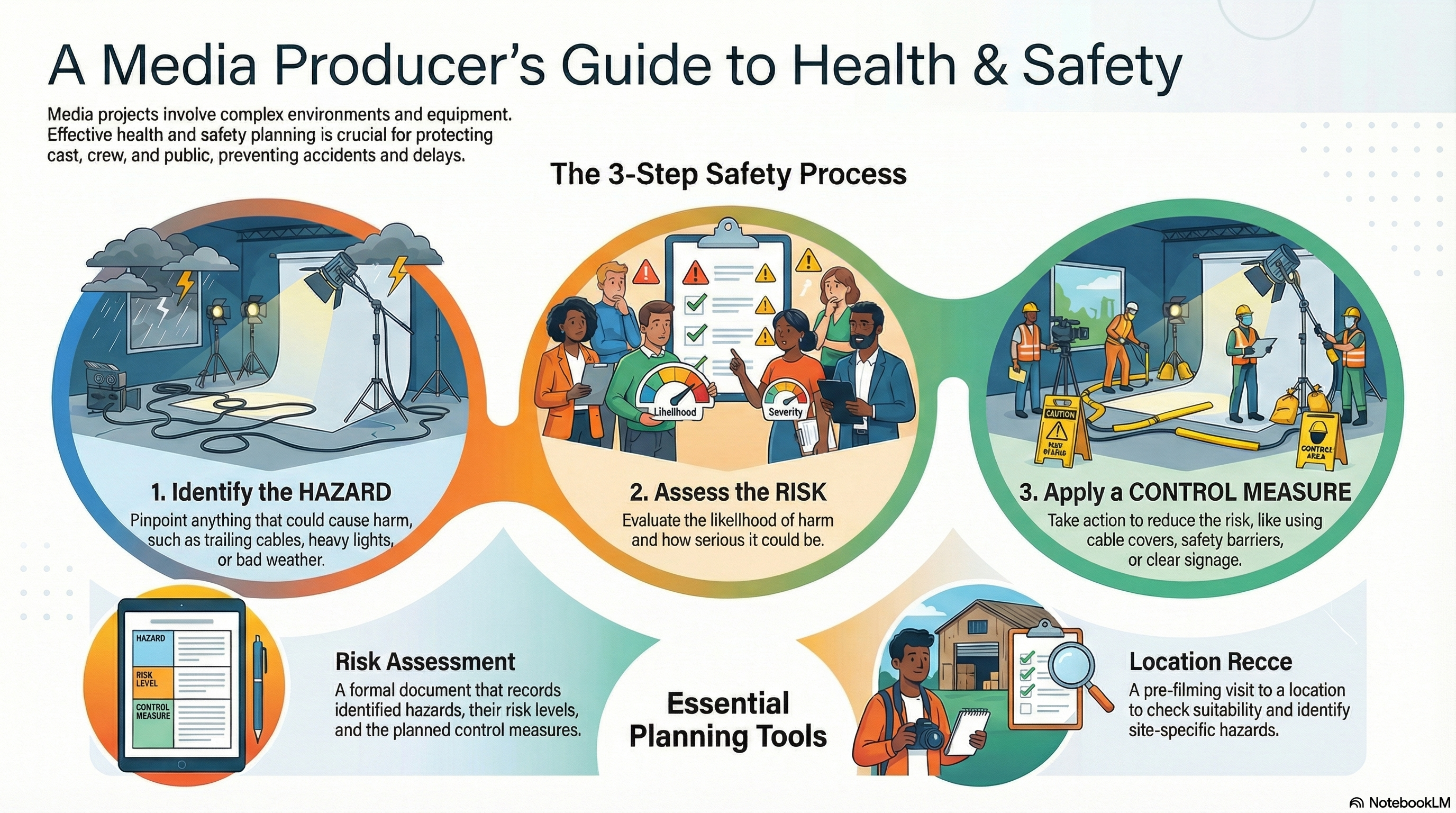
This infographic highlights key health and safety concepts and how to apply them to media production scenarios.
Hazards, Risks & Control Measures
Understanding the language of risk assessments.
Hazard: something that could cause harm (e.g. cables, vehicles, weather, equipment).
Risk: how likely it is that harm will happen and how serious it could be.
Control measure: action taken to reduce the risk (e.g. cable covers, barriers, PPE).
Likelihood & severity: often scored to prioritise which risks to deal with first.
Common media hazards: trip hazards, lighting rigs, crowds, loud sound levels, stunts.
Exam link: identify hazards in a scenario and suggest specific control measures.
Hazards · Risks · Controls
Risk Assessments & Safe Working
Planning safe shoots for locations, studios and events.
Responsibilities: producers and location managers ensure assessments are done and followed.
Briefing: communicate safety rules to cast, crew and anyone on set.
Emergency procedures: plan for fire, first aid and evacuation routes.
Documentation: keep written records of assessments and incident reports.
Exam tip: suggest realistic measures (e.g. extra staff, signage, barriers) rather than vague "be careful" answers.
Plan · Brief · Record
Hazards, Risks and Control Measures
You must be confident with key terms used in risk assessments.
Key Terms
Hazard – something that could cause harm (e.g. trailing cables, heavy equipment, traffic).
Risk – how likely it is that the hazard will cause harm, and how serious the harm could be.
Control measure – an action taken to reduce the risk (e.g. taping down cables, barriers).
Examples in Media Projects
Trailing cables from cameras and lights → risk of trips and falls.
Filming near roads → risk of traffic accidents.
Using lights → risk of burns, fire or overheating.
Filming in bad weather → slippery surfaces, equipment damage.
Control Measures
Secure or cover cables and keep walkways clear.
Use barriers, cones and clear signage around filming areas.
Check equipment regularly and do not overload power sockets.
Wear suitable clothing and footwear for the location and weather.
Risk Assessments and Recces
A risk assessment is a formal document that records hazards, risks and control measures.
A recce is a location visit carried out before filming to check suitability and safety.
Typical Contents of a Risk Assessment
Location and activity being assessed.
Identified hazards and who might be harmed.
Risk level (e.g. low/medium/high).
Control measures to reduce the risk.
Person responsible for putting measures in place.
Review date for checking the assessment again.
What Happens on a Recce?
Check access, lighting, noise levels and power supply.
Identify hazards and plan control measures.
Confirm permissions for filming (e.g. landowner, school, council).
Decide if the location is suitable for the script and equipment.
Safe Working Practices On and Off Set
Health and safety is also about everyday behaviour and policies that reduce risk during production.
Examples of Safe Working Practices
Following school or company policies for trips and location work.
Using correct manual handling techniques for heavy kit.
Ensuring only trained people operate specialist equipment.
Keeping food and drink away from electrical equipment.
Having clear emergency procedures and first-aid arrangements.
Protecting the Public and Participants
Keeping members of the public away from dangerous areas.
Obtaining consent from participants and parents/guardians for under-18s.
Making sure stunts or physical activities are appropriate and supervised.
These games put you into realistic production scenarios where you must spot hazards,
choose control measures and justify safe decisions.
Mega game · Health & safety
Health & Safety Gauntlet
Tackle production scenarios involving hazards, control measures, risk assessments and
safe working practices on and off set.
ScenariosRisk assessmentSafe practice
Legal & regulation
Legal Lightning Round
Fast-paced scenarios covering legal and regulatory issues, including health and safety
responsibilities and protecting individuals.
ScenariosLegal issuesRegulation
Pre-production
Document Doctor
Choose where risk assessments and recces fit alongside other planning documents and
identify what information they should include.
MCQsPlanning docsHealth & safety
9-mark trainer
9-Mark Ninja
Build top-band 9-mark answers explaining how productions manage health and safety
and justify control measures for different scenarios.
9 markersStructureExam technique
Exam Practice – Health & Safety (AI Marker)
Write your answers in the boxes below, then click Build & Copy AI Marking Prompt. Choose an AI tool and paste the prompt to get examiner-style marking and feedback.
Q1. State one hazard that could occur when filming an interview in a school corridor. (1 mark)
Technique: Give a clear, simple hazard such as "trailing camera cables that people could trip over".
Q2. Explain one reason why a production team should carry out a risk assessment before filming on a busy street. (2 marks)
Technique: Make one point about how the risk assessment helps (e.g. identifying traffic hazards)
and explain the impact on safety and planning.
Example structure: "A risk assessment is used to… This helps because…"
Q3. Describe three control measures that could reduce the risk of injury when using heavy lighting equipment in a studio. (3 marks)
Technique: Give three distinct measures, such as using sandbags or stands, keeping cables tidy
and ensuring only trained staff adjust the lights.
Q4. Explain two ways that poor health and safety planning could affect the success of a media project. (4 marks)
Technique: For each way, describe what might go wrong (e.g. injury, damaged equipment)
and explain how this impacts time, cost or reputation.
Q5. A college media group is planning to film a promotional video around the school site, including corridors,
staircases and outside areas. Discuss how they should manage health and safety throughout the project to
protect students, staff and the public. Provide justified recommendations. (9 marks)
Technique: Organise your answer into paragraphs (hazards, control measures, risk assessments,
recces and safe working practices). Explain specific actions and link them clearly to protecting people.
Finish with a justified conclusion.