Distribution is about getting a media product from the producer to the audience. You must
choose the right platforms, formats and methods so that the
product is high quality, easy to access and suitable for the target audience.
What Are Distribution Platforms and Media?
In R093 you need to understand how different media products reach audiences, from traditional broadcast
to online streaming and social media. This includes:
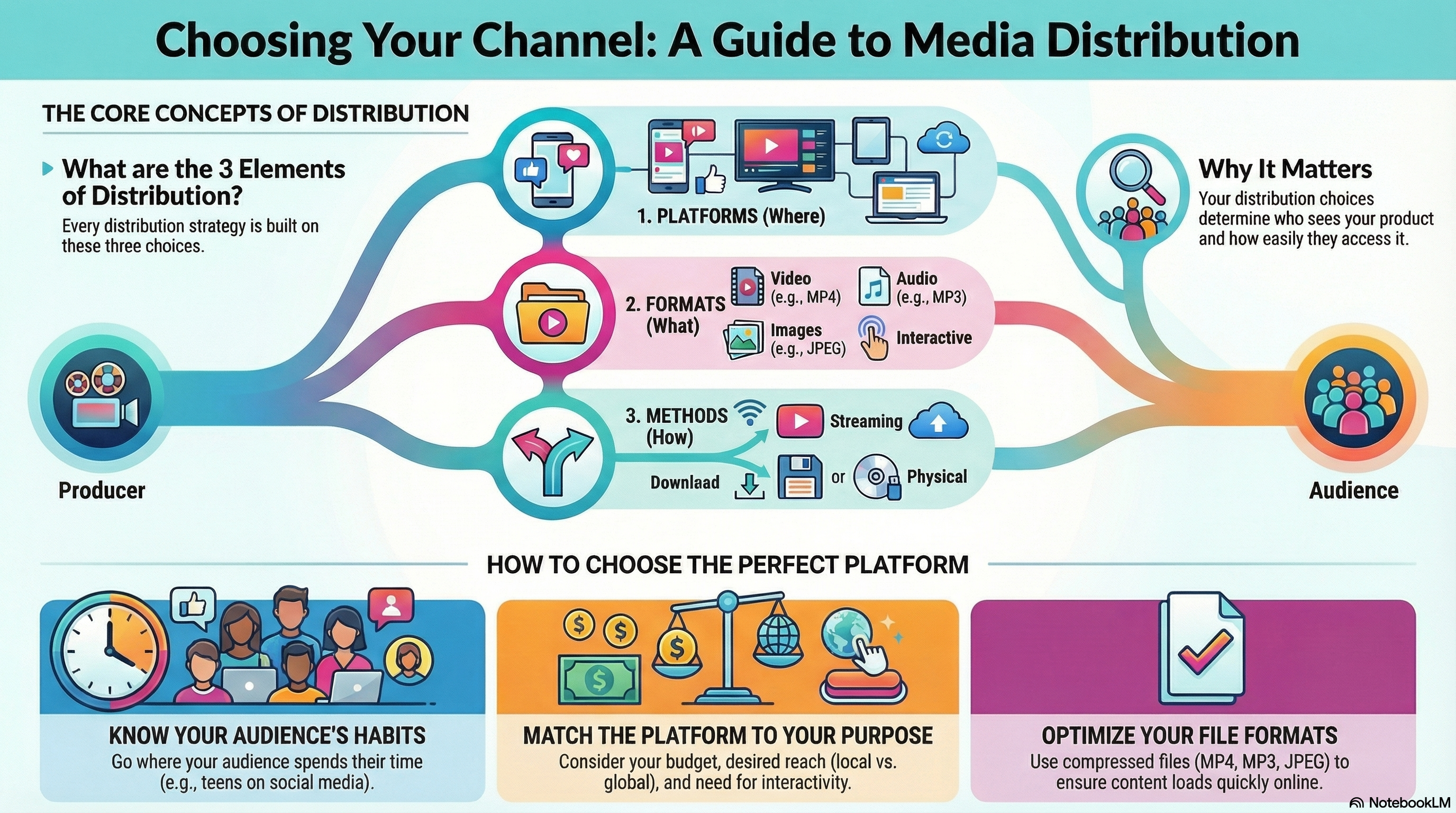
Platforms – where the product appears (TV, cinema, radio, websites, apps, social media, print).
Media and formats – the files and technologies used (video, audio, images, interactive content).
Methods – physical vs digital, streaming vs download, on-demand vs scheduled.
Why Distribution Matters
Determines who sees the product and how easily they can access it.
Affects file formats, compression and technical choices.
Often appears in the exam as scenarios where you must pick suitable platforms and justify them.
Distribution Platforms & Media at a Glance
This infographic summarises where media products can be distributed and how to match platforms to audiences.
Key Distribution Platforms
How audiences access media products in different ways.
Broadcast: TV and radio channels (live and catch-up).
Streaming & on-demand: services like Netflix, iPlayer, Spotify and YouTube.
Revision Flashcards – Distribution Platforms & Media
– / –
Loading…
Games to Practise Distribution Platforms & Media
These games help you match platforms and formats to scenarios, choose suitable file types and
build strong exam answers about distribution.
Distribution
Distribution Dash
Match client briefs to the best distribution platforms and file formats for mobile, web,
print and physical media.
MCQsFormatsPlatforms
Mega game · File types
File Types Forge
Choose the best formats and compression settings for different distribution scenarios,
from streaming trailers to downloadable posters.
Mega gameFormatsCompression
All topics
iMedia Genius
Tackle mixed R093 questions, including distribution scenarios that test your understanding
of platforms, audiences and technical choices.
Exam-styleWhole specMixed difficulty
Mixed exam
Escape Room: R093
Escape each room by answering questions from across the spec, including tricky
distribution and platform scenarios.
MixedWhole specChallenge mode
Distribution
Distribution Platforms Picker
Match media products to the best platforms and methods of distribution, explaining your choices for the exam.
Arcade quizPlatformsTargeting
Exam Practice – Distribution Platforms & Media (AI Marker)
Write your answers in the boxes below, then click Build & Copy AI Marking Prompt. Choose an AI tool and paste the prompt to get examiner-style marking and feedback.
Q1. State one advantage of distributing a music video on a video-sharing website. (1 mark)
Technique: Give a clear advantage such as "can reach a global audience quickly"
or "viewers can share the link easily".
Q2. Explain one reason why a charity might use social media as well as posters to promote an event. (2 marks)
Technique: Make one point about how social media helps (e.g. wider reach, interaction)
and explain the impact on awareness or engagement.
Example structure: "Social media is used to… This helps because…"
Q3. Describe three factors a producer should consider when choosing a platform to distribute a new short film. (3 marks)
Technique: Give three distinct factors, such as target audience, device access
and internet connection or data limits.
Q4. Explain two problems that could occur if a video is exported in an unsuitable format for a streaming platform. (4 marks)
Technique: For each problem, describe what might happen (e.g. buffering, poor quality,
incompatibility) and explain the effect on the audience experience.
Q5. A college is producing a series of short tutorial videos to help new students. Discuss how the
media team should choose distribution platforms and file formats so that the videos are easy to access
on different devices, including at home and in college. Provide justified recommendations. (9 marks)
Technique: Organise your answer into paragraphs (platform choices, file formats,
compression/quality and accessibility). Explain specific decisions and justify why they suit the
target audience and context.
Paragraph 1: Platforms – website, VLE, video-sharing site, social media links.
Paragraph 2: File formats and compression – suitable video formats and bitrates.
Paragraph 3: Access and devices – mobiles, laptops, college PCs, offline options.
Paragraph 4: Promotion – how to share links and reminders with students.
Final paragraph: Conclusion – justify the best combination of platforms and formats.
Level 2 → Level 3 Boost (Q5)
As you type, this will spot what's missing for top-band answers.
Start typing your answer to see tailored targets.
Open an AI tool:
Can You Now…?
Describe different distribution platforms and when they are suitable.
Link file formats and compression choices to distribution methods.
Recommend platforms and formats for exam-style scenarios and justify your choices.
Explain clearly how distribution affects the audience's experience of a product.