Video, audio and music work together to grab attention, set the mood and guide how audiences
feel about a product or story. They are key tools in adverts, trailers, social media clips,
games and streaming content.
What are Video, Audio & Music in Media Products?
Video (moving image) includes adverts, trailers, film clips, gameplay footage
and social media videos. It uses camera shots, angles, movement and editing to tell a story
and show information clearly.
Audio covers dialogue, voiceover, sound effects (SFX) and ambience. These
help explain ideas, create atmosphere and make actions feel more realistic.
Music is used to set the tone, support the brand identity and influence how
the audience feels. It can be specially composed or licensed from existing tracks.
Key points you must remember
Video, audio and music combine to create meaning, mood and impact for the audience.
Different camera shots and editing techniques affect how a product is presented.
Dialogue and voiceover can give information, instructions or persuasive messages.
Sound effects and music help build atmosphere and make content more memorable.
Licensing and copyright must be considered when using existing music or audio clips.
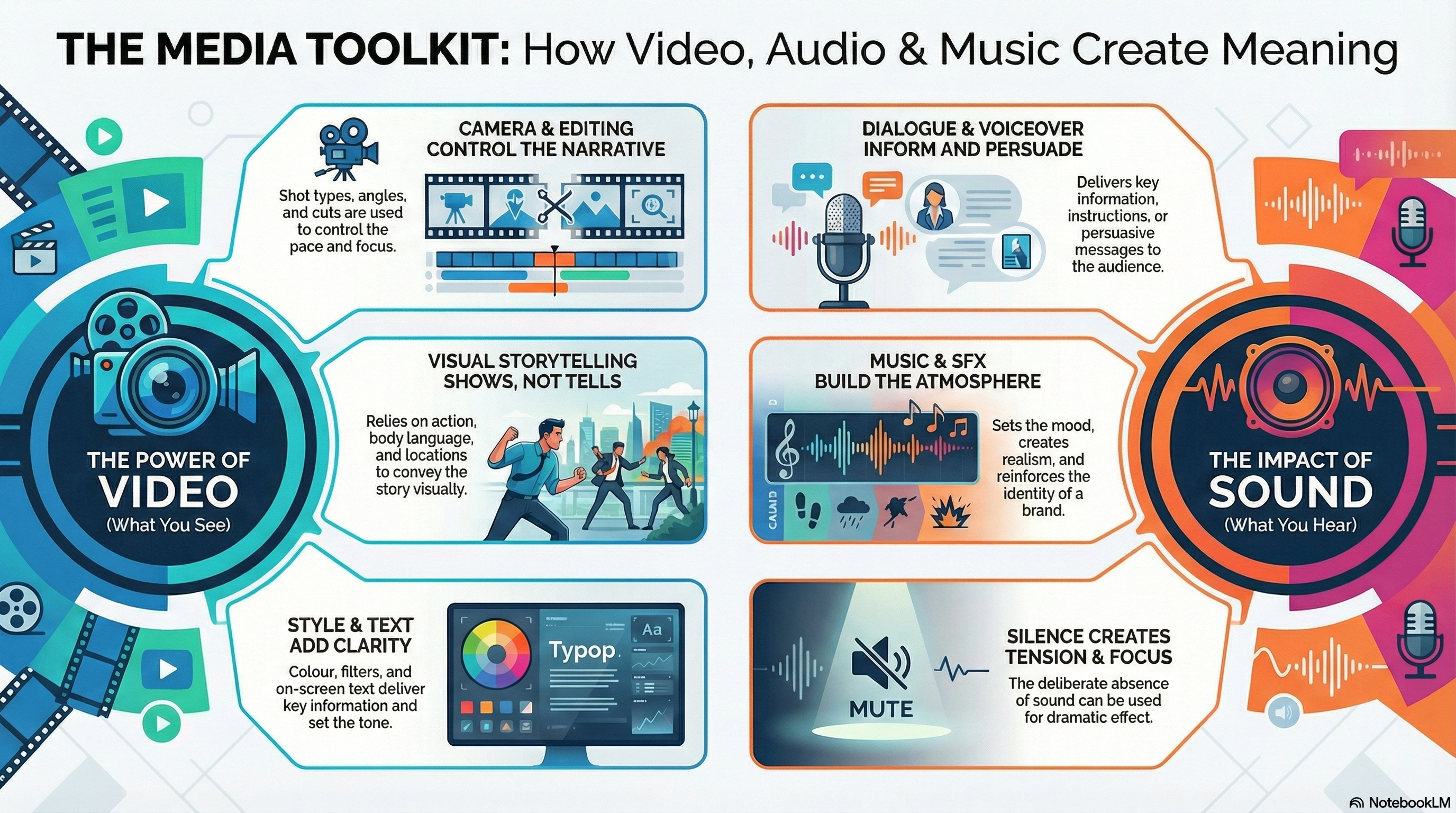
Video, Audio & Music at a Glance
This infographic reminds you how moving image, sound and music each contribute to meaning and mood.
Role of Video & Visuals
What the audience sees in a video product.
Picture content: people, locations, props and on‑screen graphics.
Camera & editing: shot types, angles and cuts that control pace and focus.
On‑screen text: titles, lower thirds and captions to convey key information.
Visual style: colour grading, filters, aspect ratio and framing.
Visual storytelling: shows rather than tells, relying on body language and action.
Exam link: always connect a visual choice to its purpose and effect on the audience.
Picture · Editing · Story
Audio & Music Working Together
Dialogue, SFX and music combine to build atmosphere.
Dialogue: what people say and how they say it (tone, pace, accent).
Use these games to practise how video, audio and music are used in products, how they link
to file types and compression, and how they help create meaning for the audience.
All topics
iMedia Genius
The flagship exam-style quiz covering every R093 question type: MCQs, short answers,
binary questions, bonus rounds and timed scoring.
Exam-styleAll R093 contentMixed difficulty
Product design
Media Codes Challenge
Identify technical, symbolic and written codes in media examples and explain how
they create meaning, impact and engagement – including camera, audio and colour.
ExplainCodes & conventionsCamera · Audio · Colour
Mega game · File types
File Types Forge
Tackle scenarios on images, audio and video to pick the best file format and compression
(lossy or lossless) for each client brief.
Mega gameFormatsCompression
Exam Practice – Video, Audio & Music (AI Marker)
Write your answers in the boxes below, then click Build & Copy AI Marking Prompt. Choose an AI tool and paste the prompt to get examiner-style marking and feedback.
Q1. State one reason why music is used in a TV advert. (1 mark)
Technique: Give a short, clear reason such as creating mood,
reinforcing the brand or making the advert more memorable.
Q2. Explain how sound effects (SFX) can improve a gameplay trailer. (2 marks)
Technique: Make one point about what SFX add (e.g. realism, impact)
and then explain the effect on the audience.
Example structure: "Sound effects improve the trailer by… This makes the audience…"
Q3. Describe one way a voiceover can be used in a charity video. (3 marks)
Technique: Describe how the voiceover works (tone, style, information given)
and then develop your answer by linking to the purpose and audience.
Q4. Explain two ways camera shots and editing can be used together to create excitement in a sports highlight video. (4 marks)
Technique: Give two separate points. For each one, link the camera shot
or movement with the editing technique, then state the effect on the audience.
Q5. A music streaming service is producing a video advert to promote its new playlist feature.
Discuss how video, audio and music could be combined effectively in the advert to engage the
target audience. (9 marks)
Technique: Cover video (shots, editing, on-screen graphics), audio
(voiceover, SFX) and music (style, tempo, branding). Explain how each one helps to inform,
persuade and engage the audience, then reach a justified conclusion.
Paragraph 1–2: Explain how video (camera shots, editing, on-screen text) could be used.
Paragraph 3: Explain how audio (dialogue, voiceover, sound effects) supports the message.
Paragraph 4: Explain how music helps create mood and reinforce the brand.
Final paragraph: Conclusion – which elements are most important and why.
Level 2 → Level 3 Boost (Q5)
As you type, this will spot what's missing for top-band answers.
Start typing your answer to see tailored targets.
Open an AI tool:
Can You Now…?
Explain how video, audio and music work together in a media product.
Give examples of how voiceover, SFX and music can be used to meet different purposes.
Plan how you would combine video, audio and music in a campaign for a specific audience.