Technical job roles focus on equipment, software and processes. They make sure cameras,
microphones, lighting, editing software and networks are set up correctly and working
smoothly so creative ideas can be turned into real products.
What are Technical Job Roles?
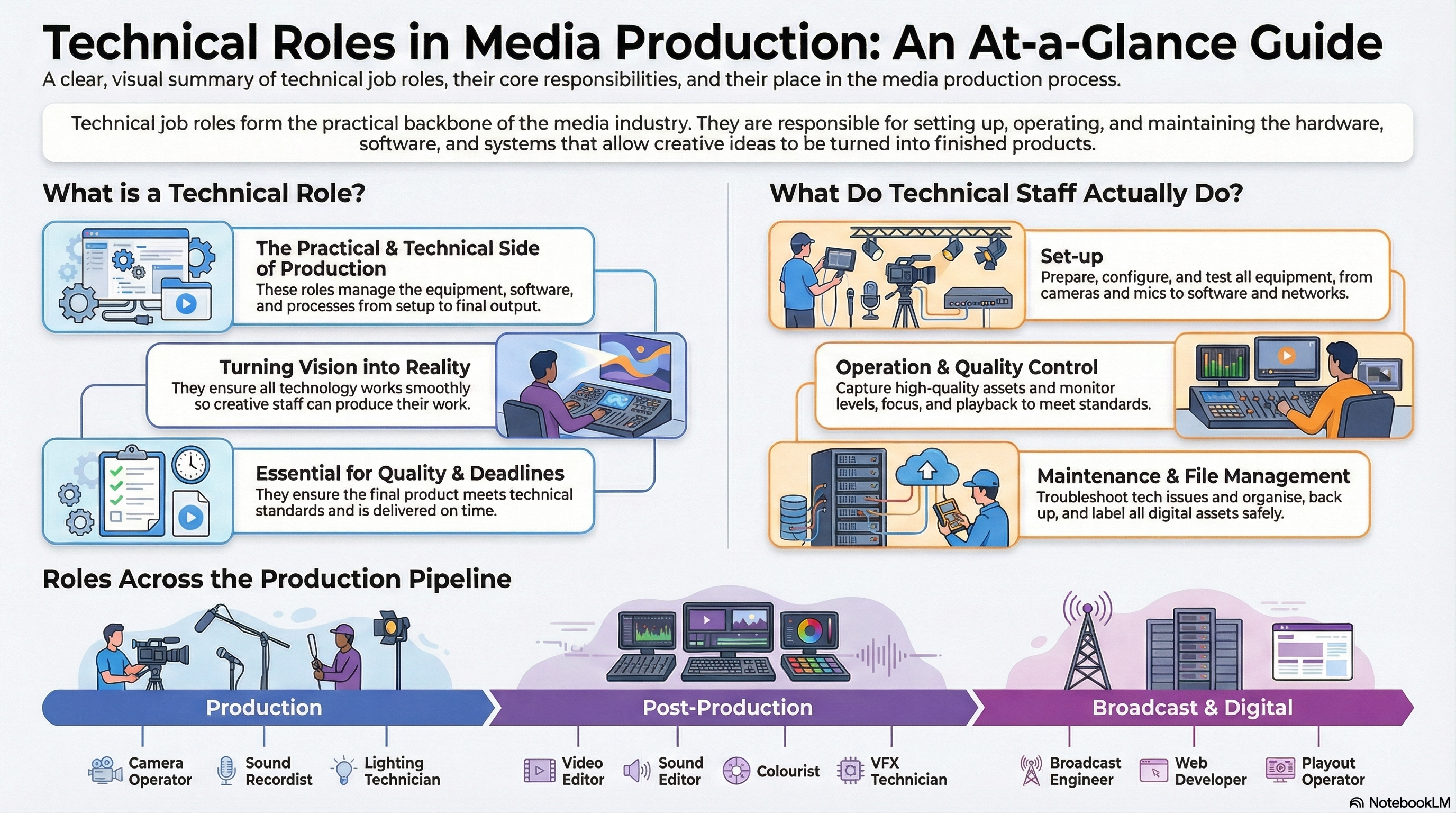
Technical job roles are responsible for the practical and technical side
of media production. These include camera operators, sound technicians, video editors,
lighting technicians, web developers, broadcast engineers and IT support staff.
They work closely with creative and senior staff to ensure that all equipment and software
is set up correctly, that files are stored safely, and that the final product meets
technical standards and deadlines.
Key points you must remember
Technical roles focus on using and maintaining hardware, software and systems.
Each technical role has specific equipment and workflows to manage.
They must follow health and safety rules when using specialist kit.
They ensure media assets are captured, edited and exported in the correct formats.
Good communication with creative and senior staff is essential to meet the brief.
Technical Job Roles at a Glance
Use this infographic to remember what technical staff actually do on a production and how to
write about their responsibilities in the exam.
Where Technical Staff Work
Key production areas that rely on technical job roles.
Production: camera operators, sound recordists, lighting technicians, studio technicians.
Post-production: video editors, sound editors, colourists, VFX technicians.
Use these games to practise matching technical roles to tasks, equipment and workflows,
and to link roles to the hardware and software they use.
Job roles
Guess Who? Job Roles
Read the clues, think about responsibilities and choose the correct production role to
build your multiplier and sharpen your score.
MCQsJob rolesResponsibilities
Mega game · Hardware & software
Hardware & Software Gauntlet
Battle through stages on input and output devices, specialist kit and the software used
in pre-production and production workflows.
Mega gameHardwareSoftware
All topics
iMedia Genius
The flagship exam-style quiz covering every R093 question type: MCQs, short answers,
binary questions, bonus rounds and timed scoring.
Exam-styleAll R093 contentMixed difficulty
Exam Practice – Technical Job Roles (AI Marker)
Write your answers in the boxes below, then click Build & Copy AI Marking Prompt. Choose an AI tool and paste the prompt to get examiner-style marking and feedback.
Q1. State one responsibility of a camera operator in a TV production. (1 mark)
Technique: Give one clear responsibility such as framing shots, operating
the camera during recording or checking focus and exposure.
Q2. Explain one reason why a production needs a sound technician on set. (2 marks)
Technique: Make one point about sound quality or clarity, then explain how
this affects the audience's experience of the product.
Example structure: "A sound technician is important because… This means that…"
Q3. Describe one difference between the role of a video editor and the role of a camera operator. (3 marks)
Technique: Identify a clear difference (e.g. capturing footage vs assembling
footage) and then develop your answer with an example of when each role works.
Q4. Explain two skills a web developer needs when building an interactive website for a client. (4 marks)
Technique: Give two separate skills (e.g. coding, problem solving,
understanding of UX). For each, explain how it helps meet the client's requirements.
Q5. A college is setting up a new media studio for students. Discuss the technical job roles
that would be involved in installing and maintaining the equipment and software, and explain
how they help keep the studio running effectively. (9 marks)
Technique: Cover several technical roles (e.g. IT technician, network
manager, broadcast engineer, studio technician) and explain their responsibilities.
Finish with a justified conclusion about why these roles are important.
Paragraph 1–2: Describe key technical roles and what they set up or maintain.
Paragraph 3: Explain how they solve technical problems and support users.
Paragraph 4: Link their work to reliability, safety and meeting deadlines.
Final paragraph: Conclusion – why strong technical support is vital for production.
Level 2 → Level 3 Boost (Q5)
As you type, this will spot what's missing for top-band answers.
Start typing your answer to see tailored targets.
Open an AI tool:
Can You Now…?
Name at least three technical job roles and describe what they do.
Explain how technical roles support creative and senior staff.
Suggest which technical roles would be needed for different media projects.