Secondary research uses information that already exists – such as reports, websites, analytics
or publications. It is cheaper and faster than primary research, but may be less specific or
up to date.
What is Secondary Research?
Secondary research is information that has already been collected by someone else.
Media producers use it to understand trends, audiences, competitors and markets without having to
collect new data from scratch.
Common sources include websites, books, journals, news articles, market research reports, viewing
figures and social media analytics. These sources can give a quick overview of the market and help
you make early decisions about a project.
Key points you must remember
Secondary research uses existing data collected by other individuals or organisations.
Examples include online articles, statistics, academic research, market reports and competitor analysis.
It is usually cheaper and quicker than primary research, but may be outdated or not specific enough.
You must always consider the reliability and bias of your sources.
Often used at early stages of a project to gain background understanding before doing primary research.
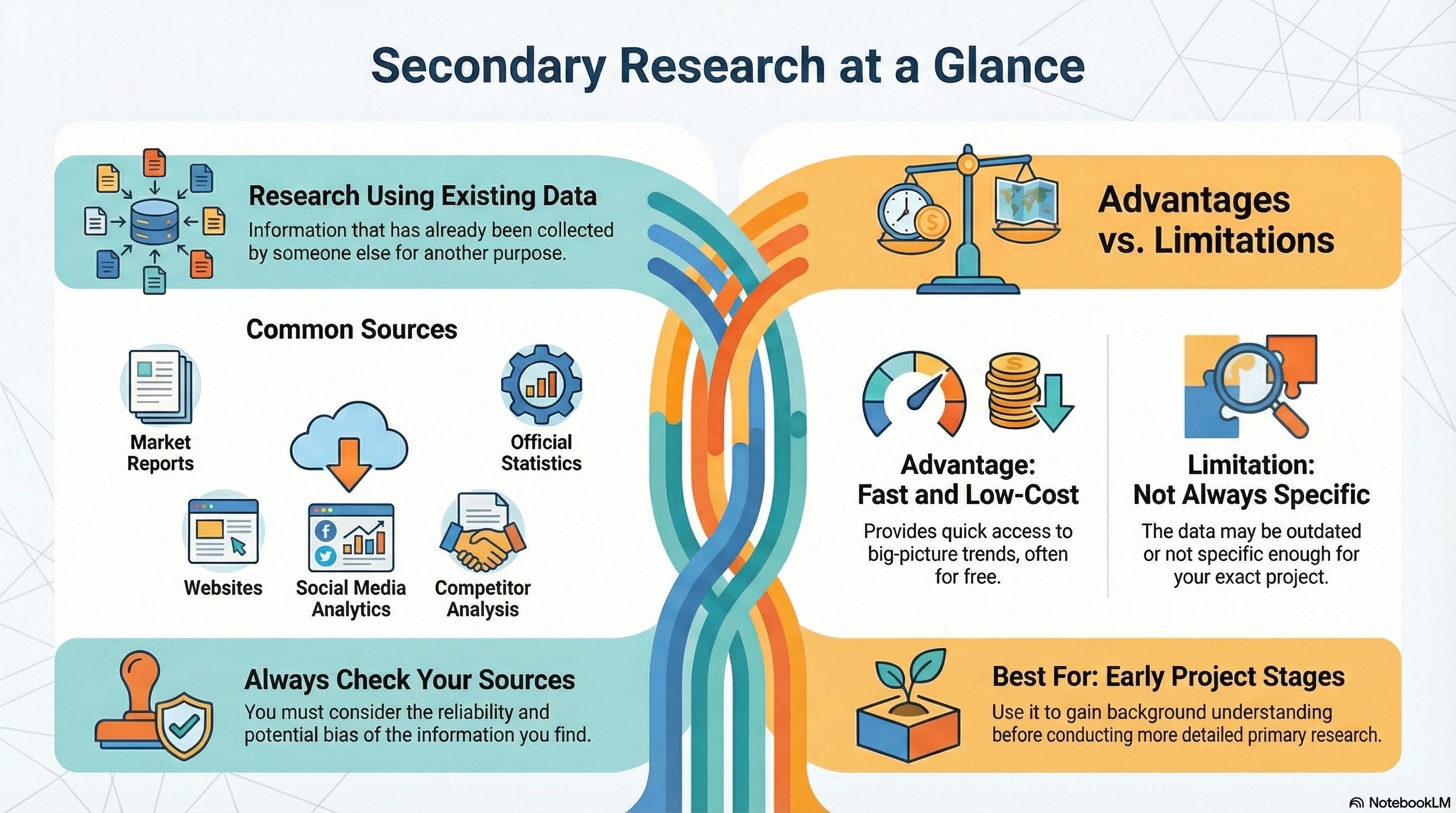
Secondary Research at a Glance
This infographic explains what secondary research is, where to find it and how to judge its usefulness.
Sources of Secondary Research
Existing data you can use instead of collecting everything yourself.
Websites & blogs: articles, reviews and news stories about products and markets.
Reports & journals: market research reports, academic studies, industry white papers.
Official statistics: government data, viewing figures, box office and sales figures.
Analytics: website traffic, app store data, social media insights and engagement stats.
Competitor analysis: researching rival products, campaigns and branding.
Exam link: explain what information you would look for and how it would influence your ideas.
Existing Data · Insights
Advantages, Limitations & Comparison
How to compare secondary research with primary research.
Advantages: quick to access, often low-cost or free, good for big-picture trends.
Limitations: may be out of date, not specific to your project or target audience.
Good for: early project stages, understanding markets, informing initial ideas.
Less good for: detailed feedback on your exact design or prototype.
Comparison: use both primary and secondary research to show a stronger argument.
Exam tip: write "Secondary research is suitable here because…" and link to time/budget/trends.
Use these games to practise choosing when to use secondary research, evaluating sources
and explaining the advantages and disadvantages of different methods.
Mega game · Research methods
Research Methods Adventure
Work through staged challenges on primary and secondary research, quantitative vs qualitative
data and reliability before a project begins.
Mega gamePrimary & secondaryReliability
Mixed exam
Explain It! 2-Mark Engine
Practise perfect 2-mark answers for advantages, disadvantages and differences
with instant feedback on structure and detail.
2 markersPEE structureTargeted practice
All topics
iMedia Genius
The flagship exam-style quiz covering every R093 question type: MCQs, short answers,
binary questions, bonus rounds and timed scoring.
Exam-styleAll R093 contentMixed difficulty
Exam Practice – Secondary Research (AI Marker)
Write your answers in the boxes below, then click Build & Copy AI Marking Prompt. Choose an AI tool and paste the prompt to get examiner-style marking and feedback.
Q1. State one example of secondary research. (1 mark)
Technique: Give one clear example such as market reports, website analytics,
online articles or viewing figures.
Q2. Explain one advantage of using secondary research when starting a new media project. (2 marks)
Technique: Make one point about speed, cost or access to large data sets,
then explain how this helps the producer make better decisions.
Example structure: "Secondary research is useful because… This means that…"
Q3. Describe one limitation of relying only on online articles for secondary research. (3 marks)
Technique: Describe a specific limitation (e.g. bias, outdated information,
unreliable sources) and then develop your answer by explaining how this could mislead the producer.
Q4. Explain two reasons why checking the reliability of secondary sources is important. (4 marks)
Technique: Give two separate reasons (e.g. avoiding incorrect decisions,
protecting reputation, ensuring information is up to date). For each, explain the impact on
the project if the source is unreliable.
Q5. A company wants to release a new streaming app. Discuss how secondary research could help
them understand the market and audience expectations, and explain the limitations of relying
only on secondary data. (9 marks)
Technique: Refer to different types of secondary data (market reports,
competitor analysis, usage statistics, reviews). Explain how each helps with decisions about
features, pricing and marketing. Then discuss limitations and why primary research might also
be needed. Finish with a justified conclusion.
Paragraph 1: Outline useful secondary sources and what they show about the market.
Paragraph 2: Explain how this data influences decisions about features and marketing.
Paragraph 3: Discuss limitations such as lack of project-specific detail or outdated data.
Final paragraph: Conclusion – how secondary and primary research could work together.
Level 2 → Level 3 Boost (Q5)
As you type, this will spot what's missing for top-band answers.
Start typing your answer to see tailored targets.
Open an AI tool:
Can You Now…?
Define secondary research and give examples of sources.
Explain advantages and disadvantages of using secondary research.
Choose appropriate secondary research sources for different media projects and justify your choices.