Camera and lighting are powerful technical codes. The shots you choose, how you frame a subject
and the way you light the scene all change how the audience feels and what they notice.
What Do Camera and Lighting Do in a Media Product?
In R093, you must understand how camera work and lighting are used as
technical codes. They help producers:
Draw attention to important details or characters.
Create a specific mood (e.g. tense, exciting, calm).
Represent characters in a certain way (powerful, weak, friendly, mysterious).
Support the purpose of the product (e.g. persuade, inform, entertain).
Key Camera Concepts
Shot types – how much of the subject and background is shown.
Angles – where the camera is positioned (high, low, eye-level).
Movement – how the camera moves (pan, tilt, tracking, handheld).
Framing and composition – rule of thirds, headroom and lead room.
Low-key lighting – strong contrast, deep shadows, dramatic mood.
Colour gels – coloured lights used to change mood (e.g. red, blue, green).
Natural vs artificial light – daylight compared with studio lights or LED panels.
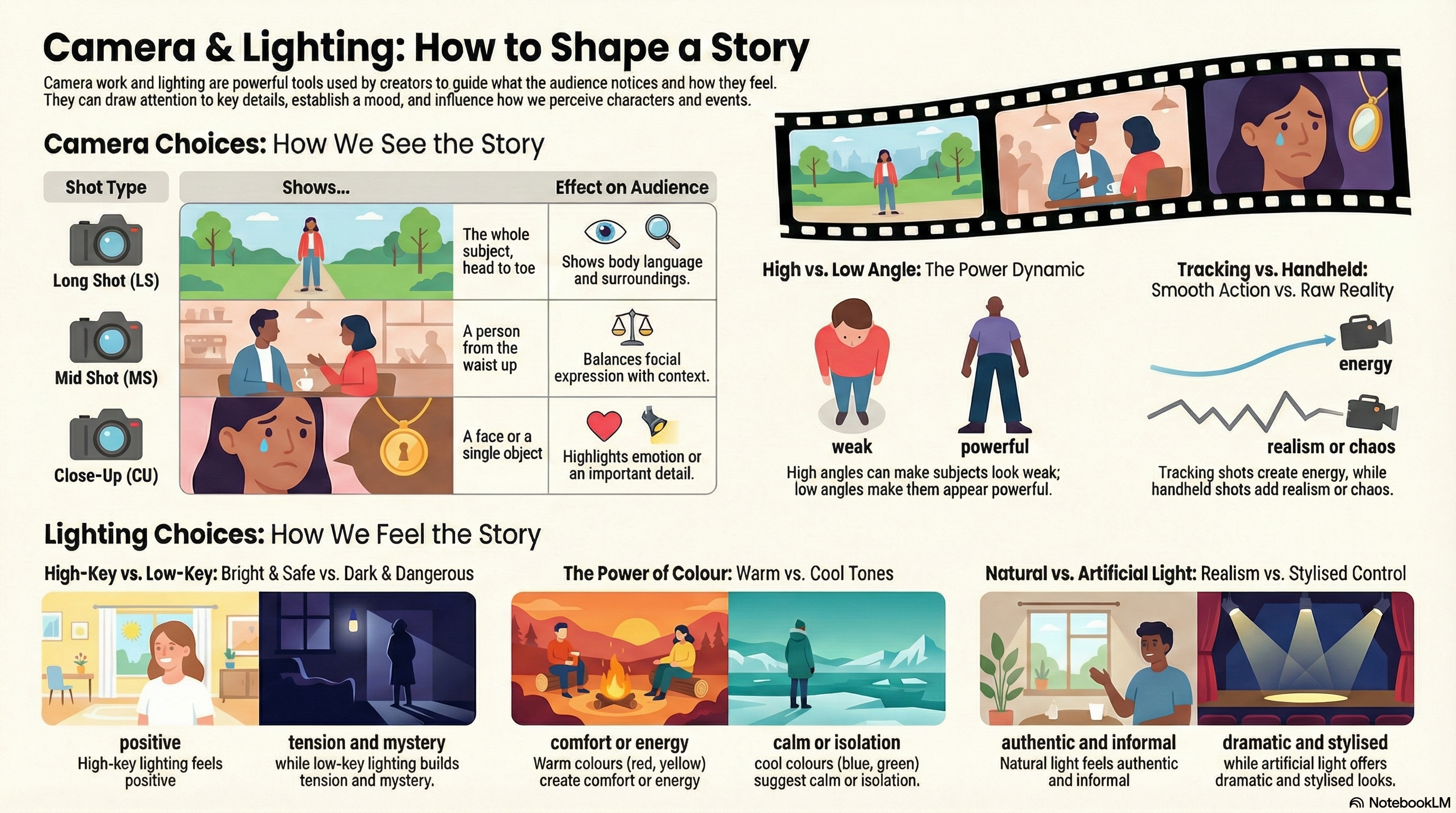
Camera & Lighting at a Glance
Use this infographic to remember how camera and lighting choices act as technical codes and how to
explain their impact on the audience.
Key Camera Choices
Shot types, angles and movement that create meaning.
Shot types: close-up to show emotion, mid shot for body language, long shot for setting.
Angles: high angle to make a subject look weak, low angle to make them look powerful.
Movement: pans and tilts to follow action, tracking shots to move with characters.
Framing: rule of thirds, headroom and lead room to keep compositions balanced.
Focus: shallow depth of field to highlight one subject, deep focus to show the whole scene.
Exam link: name the camera choice and explain how it affects the audience's view of a character or event.
Shots · Angles · Movement
Lighting & Mood
How lighting style changes the mood and meaning of a scene.
High-key lighting: bright, even lighting for cheerful, safe or professional scenes.
Low-key lighting: strong shadows and contrast for tension, mystery or danger.
Colour gels: warm tones for comfort or romance, cool tones for calm or isolation.
Direction of light: front lighting for clarity, side lighting for drama, backlighting for silhouettes.
Natural vs artificial: realism vs stylised looks depending on the product's purpose.
Exam tip: use the pattern "The use of [lighting type] creates a [mood] because…" and link to audience response.
Mood · Atmosphere · Focus
Camera Shots, Angles and Movement
Camera choices are deliberate. In the exam, you must be able to identify shot types,
angles and movement, then explain their effect on the audience.
Shot Types
Extreme long shot (ELS) – shows a wide area or landscape.
Effect: establishes the setting and scale of the scene.
Long shot (LS) – shows the whole subject, usually head to toe.
Effect: lets the audience see body language and surroundings.
Mid shot (MS) – usually shows a person from the waist up.
Effect: balances facial expression with context, common in interviews.
Close-up (CU) – shows a face or single object in detail.
Effect: highlights emotion or focuses on an important prop.
Extreme close-up (ECU) – focuses on one detail (eyes, a button, a logo).
Effect: creates intensity and makes the detail feel important or dramatic.
Camera Angles
High angle – camera looks down on the subject.
Effect: can make them seem weaker, smaller or less powerful.
Low angle – camera looks up at the subject.
Effect: makes them appear powerful, confident or threatening.
Eye-level angle – camera is level with the subject's eyes.
Effect: feels natural and neutral, like a normal conversation.
Camera Movement
Pan – camera turns left or right from a fixed position.
Effect: follows action or reveals more of the scene.
Tilt – camera moves up or down.
Effect: can reveal height, make a character look powerful, or show something important.
Tracking / dolly shot – camera moves along with the subject.
Effect: adds energy and helps the audience feel part of the action.
Handheld camera – camera is held by hand, creating a shaky effect.
Effect: makes footage feel realistic or chaotic, like a documentary or POV.
Lighting and Mood
Lighting helps to set the mood, highlight important parts of the frame and support the message of
the product. Different lighting styles create different reactions in the audience.
Lighting Styles
High-key lighting – bright and evenly lit.
Used for: comedies, daytime TV, adverts aimed at families or children.
Effect: creates a positive, safe and friendly atmosphere.
Low-key lighting – lots of shadows and contrast.
Used for: thrillers, horror, dramatic scenes.
Effect: builds tension, mystery or fear.
Three-point lighting – key, fill and back light.
Used for: interviews, studio filming, professional looks.
Effect: separates the subject from the background and looks polished.
Colour and Gels
Warm colours (orange, yellow, red) Effect: feel cosy, energetic or urgent depending on context.
Cool colours (blue, green) Effect: suggest calm, technology or sometimes sadness.
Coloured gels placed over lights
Effect: change the emotional tone of a scene and support branding or genre.
Natural vs Artificial Light
Natural light – sunlight, daylight from windows.
Effect: can feel realistic, fresh and informal.
Artificial light – studio lights, LEDs, spotlights.
Effect: gives more control, can be dramatic and stylised.
These games help you apply your knowledge of technical codes, colour and representation when
analysing media products.
Product design
Media Codes Challenge
Identify technical codes such as camera shots and lighting in media examples and explain how
they create meaning and impact.
Explain camera & lightingCodes & conventions
Product design
Colour Critic
Evaluate how colour and contrast are used in posters, logos and adverts, then choose the best
option for the target audience.
MCQsColourContrast
Pre-production
Script Surgeon
Upgrade a weak advert script by adding camera directions and lighting cues, then justify how
they improve the final product.
9 markersScriptsCamera directions
Mixed exam
Exam Styles Showdown
Compare different student answers about camera and lighting and choose the one that would score
the most marks.
Exam-styleCommand wordsModel answers
Camera & movement
Camera Command
Choose the best shot type, angle and movement to create meaning – just like a camera operator in R093 questions.
Arcade quizShots & anglesMovement
Exam Practice – Camera and Lighting (AI Marker)
Write your answers in the boxes below, then click Build & Copy AI Marking Prompt. Choose an AI tool and paste the prompt to get examiner-style marking and feedback.
Q1. State one camera shot type that could be used in a film poster. (1 mark)
Technique: Just name a valid shot type, e.g. close-up, mid shot or long shot.
Q2. Explain one reason why a close-up might be used in a charity advert. (2 marks)
Technique: Make one clear point and then explain the effect on the audience.
Example structure: "A close-up is used to show… This makes the audience feel…"
Q3. Describe how low-key lighting could be used in a horror film trailer. (3 marks)
Technique: Describe the lighting choice (shadows, contrast) and explain how it
builds tension or fear in the audience.
Q4. Explain two ways that camera movement can make an action sequence more exciting. (4 marks)
Technique: Give two separate camera movements (e.g. tracking shot, handheld camera)
and, for each one, explain how it increases energy or immersion.
Q5. A sportswear brand is creating an online video advert for teenagers. Discuss how camera and
lighting choices could be used to make the advert appealing and dynamic. Provide justified
recommendations. (9 marks)
Technique: Refer to shot types, camera movement and lighting style. Explain how each
choice appeals to teenagers (e.g. energy, aspiration, realism). Finish with a clear conclusion about
which combination will work best and why.
Paragraph 1: Shot types and angles – how they present the athletes and product.
Paragraph 2: Camera movement – tracking, handheld, point-of-view for energy.