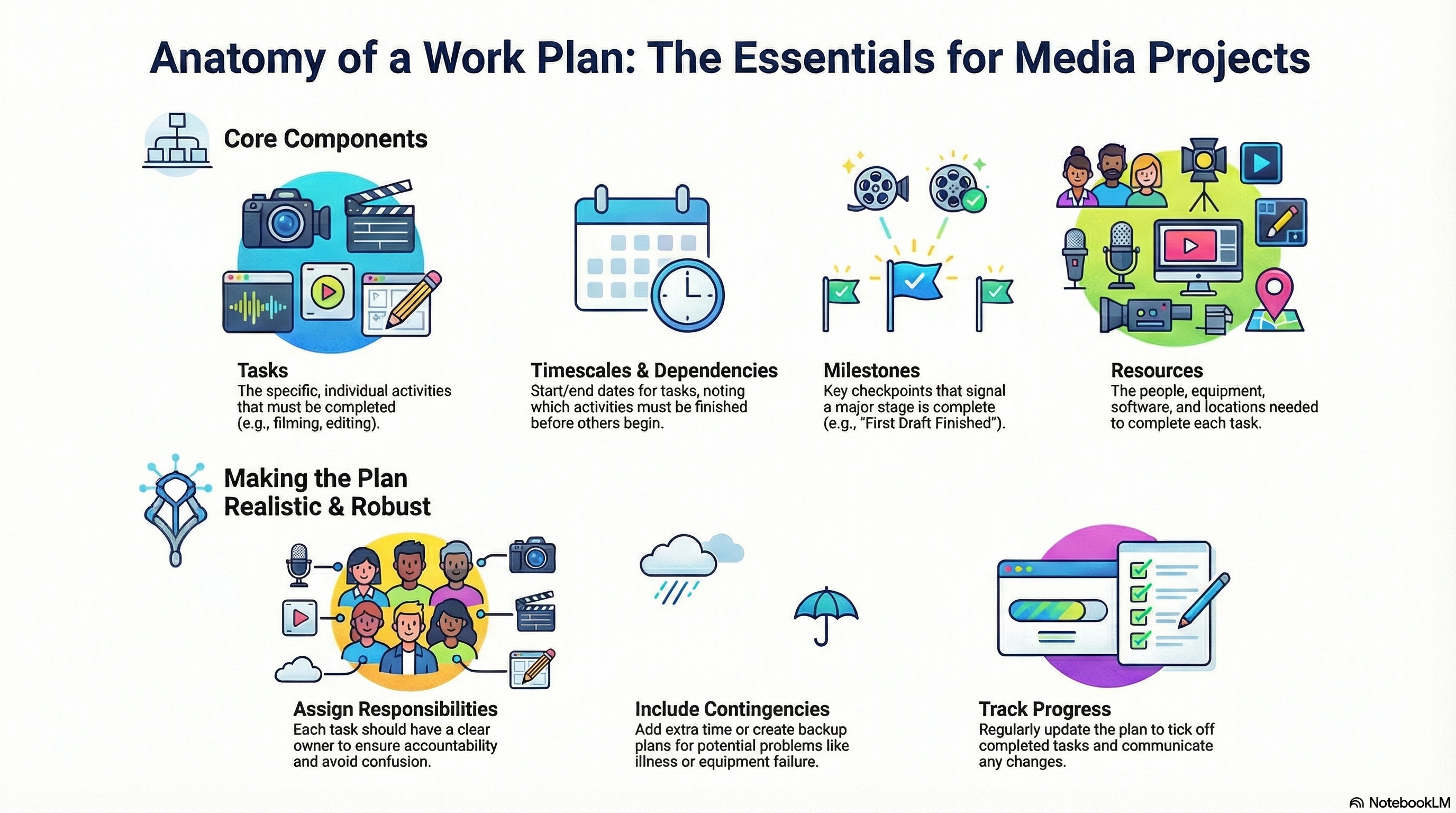
A work plan breaks a project into clear tasks, with realistic timings,
milestones and resources. In R093 you need to recognise these components
and explain why they are essential for delivering a successful media product on time.
What Is a Work Plan?
A work plan (or production schedule) sets out what needs to be done,
when it will be done, who will do it and what resources
are needed. It helps teams stay organised and meet deadlines.
In R093, you must be able to identify and explainrecommend improvements to make a plan more realistic.
Key Components of a Work Plan
Tasks – individual activities that must be completed.
Contingency time: spare time added to absorb small delays.
Responsibility: assigning team members to each task.
Tracking progress: ticking off tasks, updating the plan and communicating changes.
Exam tip: suggest specific changes (e.g. add contingency, combine tasks) instead of vague comments.
Realistic · Flexible · Trackable
Tasks, Timescales, Milestones and Deadlines
Work plans usually appear as tables or Gantt charts, showing tasks along a timeline.
You should be able to read these and explain how they help manage a project.
Tasks and Activities
Tasks should be clear and specific (e.g. "record voiceover", not just "audio").
Tasks can be grouped into phases such as planning, production and review.
Each task should have a clear owner (person responsible).
Timescales and Durations
Each task has a start date and end date or a duration (e.g. 2 days).
Tasks should be ordered logically, taking into account any dependencies
(e.g. you can't film before the script is finished).
Realistic timescales reduce the risk of delays and rushed work.
Milestones and Deadlines
Milestones are key points such as "filming complete" or "first draft finished".
They help track progress and check the project is on schedule.
Deadlines are final due dates for deliverables (e.g. launch date, client review).
Resources, Responsibilities and Contingencies
A good work plan also makes sure that the right people, equipment and
locations are available at the right time, with backup plans if something changes.
Resources
People – designer, camera operator, editor, sound engineer, actors, testers.
These games help you apply your knowledge of tasks, timings and project phases when building
or evaluating work plans for different media products.
Pre-production
Pre-Production Race
Build a work plan by placing tasks into pre-production, production and post-production,
then add milestones and contingency time to keep the project realistic.
Short answersWork plansPhases
Pre-production
Work Plan Detective
A staged Mega Game where you analyse work plans, fix timing issues, identify poor sequencing,
add contingencies and judge whether a plan is realistic.
Mega gameTasksTimingsMilestones
Pre-production
Document Doctor
Choose the right planning document for each task and identify key components, including
where a detailed work plan is needed in the production process.
MCQsPlanning docsComponents
Pre-production
Mind Map Makeover
Improve weak mind maps so they provide a solid foundation for later documents like
work plans, scripts and storyboards.
9 markersMind mapsImprovements
9‑mark trainer
9‑Mark Ninja
Build high‑band 9‑mark answers that justify planning decisions, including why work plans,
milestones and contingencies are vital in media projects.
9 markersStructurePlanning
9-mark trainer
9-Mark AI Trainer
Write a full 9-mark answer using real R093-style scenarios, then generate an AI marking prompt to get a score and feedback.
9 markersFull answersAI feedback
Exam Practice – Components of Work Plans (AI Marker)
Write your answers in the boxes below, then click Build & Copy AI Marking Prompt. Choose an AI tool and paste the prompt to get examiner-style marking and feedback.
Q1. State one component of a work plan. (1 mark)
Technique: Give a single, clear component such as "tasks", "milestones" or "resources".
Q2. Explain one reason why contingencies are included in a work plan. (2 marks)
Technique: Make one clear point about what contingencies are, then explain how they help
the project if something goes wrong.
Example structure: "Contingencies are… This helps because…"
Q3. Describe how milestones can help the project manager monitor progress during production. (3 marks)
Technique: Refer to specific milestones and explain how they show whether the project
is on schedule or behind.
Q4. Explain two ways that unrealistic timescales in a work plan could affect the final media product. (4 marks)
Technique: For each way, describe the issue (e.g. rushed editing) and explain how it
impacts quality, deadlines or client satisfaction.
Q5. A college is planning to produce a promotional video for its open evening. Discuss how tasks,
timescales, milestones, resources and contingencies should be used within a work plan to ensure
the project is completed on time and to a high standard. Provide justified recommendations. (9 marks)
Technique: Organise your answer into paragraphs for different components of the work plan.
For each, explain what you would include and why it helps this specific project, then finish with a clear,
justified conclusion.