Media producers must follow the law to protect individuals. This includes how personal
data is collected and stored, how people are kept safe during production, and how content avoids
harming or exploiting audiences.
What Does "Protecting Individuals" Mean in R093?
In R093, legal considerations to protect individuals focus on rules that keep people's
data, privacy, safety and wellbeing
safe when media products are planned, produced and distributed.
Data protection – keeping personal information secure and only using it fairly.
Privacy – respecting individuals' rights not to be filmed, tracked or exposed without consent.
Consent – getting permission to collect data, use images or record people.
Safety and safeguarding – protecting participants, especially children and vulnerable people.
Why It Matters in the Exam
Short questions may ask you to identify a legal consideration or give an example.
Explain questions may ask you to justify how a production protects individuals.
9-mark questions can ask you to discuss legal and ethical issues in detail.
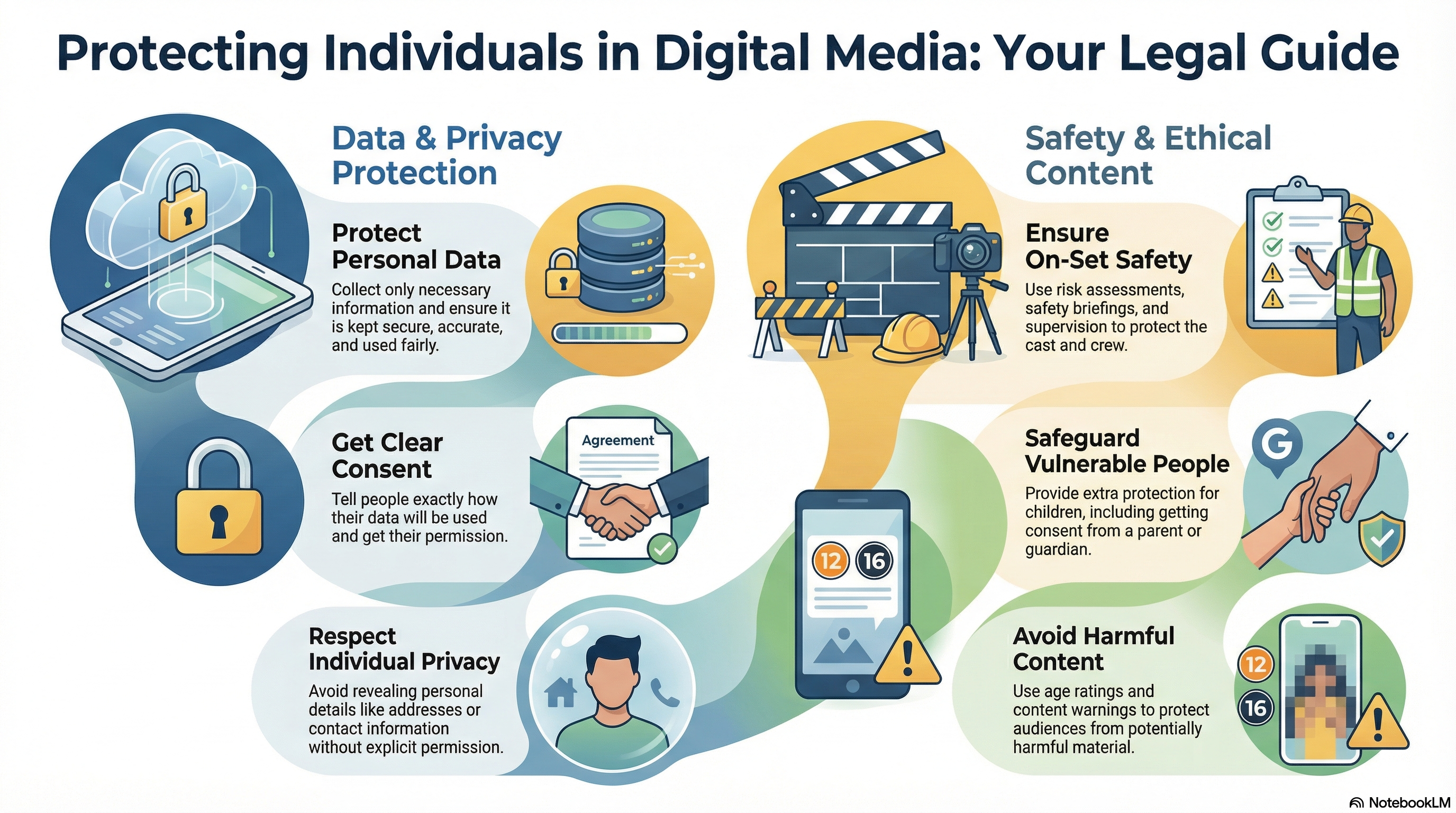
Legal Considerations to Protect Individuals at a Glance
This infographic focuses on how laws keep people's data, privacy and wellbeing safe in media projects.
Data & Privacy Protection
Laws that control how personal information is collected and used.
Data protection: collect only necessary data and keep it secure and accurate.
Consent: tell people how their data will be used and get permission where required.
Privacy: avoid revealing personal details (addresses, contact info, sensitive data).
Retention: do not keep data longer than needed for the stated purpose.
Exam link: when planning a product, explain how you would handle personal data safely.
Consequences: fines, legal action and reputational damage if laws are broken.
Data · Consent · Security
Safety, Wellbeing & Ethical Content
Protecting people during production and when content is shared.
On-set safety: risk assessments, training and supervision for cast and crew.
Safeguarding: extra protection for children and vulnerable people.
Consent to appear: release forms for people whose image, voice or data is used.
Harmful content: avoid material that could cause physical, emotional or psychological harm.
Exam tip: link legal and ethical points to real production decisions (locations, stunts, topics).
Documentation: keep clear records of permissions, risk assessments and training.
Safety · Safeguarding · Ethics
Data Protection and Privacy
When media producers collect or use personal data, they must follow data protection laws (for example,
the UK GDPR and Data Protection Act). These are not expected in heavy detail at GCSE, but you should
understand the principles.
Personal Data Examples
Names, addresses and contact details.
Date of birth, school, workplace.
Photos and video where people can be recognised.
Online identifiers such as usernames or tracking IDs.
Key Principles (Simplified)
Collect only data that is necessary for a clear purpose.
Keep data secure (passwords, encryption, access control).
Do not keep data for longer than needed.
Use data in a way that is fair, lawful and transparent.
Protecting Privacy in Media Projects
Explain clearly how data (e.g. competition entries, sign-ups) will be used.
Give users options to opt in or opt out of marketing.
Avoid sharing personal details publicly without permission.
Consent, Model Releases and Safeguarding
When individuals appear in media products (photos, videos, interviews), producers must make sure
they have consent and that people are kept safe during production.
Consent and Model Release Forms
Consent – individuals agree to take part and have their image or voice used.
Model release forms – written permission to use someone's image in specific ways.
Forms usually state where and how the media will be used and for how long.
Protecting Children and Vulnerable People
Get consent from a parent/guardian for under-18s.
Follow school or organisation safeguarding policies.
Avoid content that could embarrass, exploit or put individuals at risk.
On-set Safety and Wellbeing
Carry out risk assessments for filming locations and activities.
Provide clear safety briefings to everyone involved.
Have first-aid arrangements and emergency contacts available.
Harmful or Inappropriate Content
Media producers must also think about how content might affect individuals and audiences. Legal and
regulatory frameworks (such as classification boards, broadcasting codes and platform policies) exist
to reduce harm.
Examples of Potential Harm
Graphic violence or disturbing images.
Offensive language, hate speech or discriminatory behaviour.
Content that could encourage dangerous behaviour.
Invasion of privacy or publishing sensitive personal information.
Protecting Audiences
Use age ratings and platform restrictions where appropriate.
Provide content warnings for sensitive topics.
Avoid stereotyping or misrepresenting individuals or groups.
Use the NotebookLM for this topic to revise scenarios involving data protection, consent,
safeguarding and harmful content, then quiz yourself using its tools.
Revision Flashcards – Legal Considerations to Protect Individuals
– / –
Loading…
Games to Practise Legal Protection of Individuals
These games help you apply legal and safety rules to realistic exam-style scenarios where individuals
must be protected.
Mega game · Health & safety
Health & Safety Gauntlet
Work through production scenarios and decide how to keep individuals safe using risk assessments,
control measures and safe working practices.
ScenariosRisk assessmentSafe practice
Mega game · Intellectual property
IPR Gauntlet
Practise applying copyright, trademarks and licensing to protect individuals' work and
avoid legal problems in media projects.
Mega gameCopyrightIPR
Pre-production
Document Doctor
Identify where consent forms, risk assessments and location permissions fit alongside other
planning documents for different project briefs.
MCQsPlanning docsLegal
9-mark trainer
9-Mark Ninja
Build high-band 9-mark answers that discuss legal considerations and explain how media producers
protect individuals in different scenarios.
9 markersStructureExam technique
Exam Practice – Legal Considerations to Protect Individuals (AI Marker)
Write your answers in the boxes below, then click Build & Copy AI Marking Prompt. Choose an AI tool and paste the prompt to get examiner-style marking and feedback.
Q1. State one example of personal data that a media company must protect. (1 mark)
Technique: Give a clear, simple example such as a person's full name,
address, email or photograph.
Q2. Explain one reason why a media producer should use consent forms when filming interviews with students. (2 marks)
Technique: Make one point about how consent protects individuals (e.g. control over how
their image is used) and then explain the impact for the producer or school.
Example structure: "Consent forms are used to… This helps because…"
Q3. Describe three ways a production team can protect individuals during a location film shoot. (3 marks)
Technique: Give three distinct measures, such as risk assessments, safety briefings
and limiting access to hazardous areas.
Q4. Explain two risks to individuals if a media company does not follow data protection principles. (4 marks)
Technique: For each risk, describe what could happen (e.g. data leaks, identity theft,
unwanted contact) and explain how this affects the individual.
Q5. A college wants to create a social media campaign that includes student photos, short interviews
and an online competition. Discuss the legal considerations the media team must follow to protect
the students involved, and how these should be applied in practice. Provide justified recommendations. (9 marks)
Technique: Structure your answer into clear paragraphs (data protection, consent,
safeguarding and content). For each area, explain specific actions the team should take and link
them back to protecting individuals. Finish with a justified conclusion.
Paragraph 1: Data protection – collecting, storing and using student information securely.
Paragraph 2: Consent – permission for photos, interviews and competition entries.
Paragraph 3: Safeguarding and safety – supervision, appropriate content and avoiding risk.
Paragraph 4: Harmful content and privacy – avoiding embarrassment, bullying or misuse.
Final paragraph: Conclusion – justify which steps are most critical and why.
Level 2 → Level 3 Boost (Q5)
As you type, this will spot what's missing for top-band answers.
Start typing your answer to see tailored targets.
Open an AI tool:
Can You Now…?
Give examples of how media producers protect individuals' data, privacy and safety.
Explain why consent, safeguarding and risk assessments are important.
Identify legal considerations in exam scenarios and suggest suitable actions.
Write exam answers that link legal rules clearly to protecting individuals.