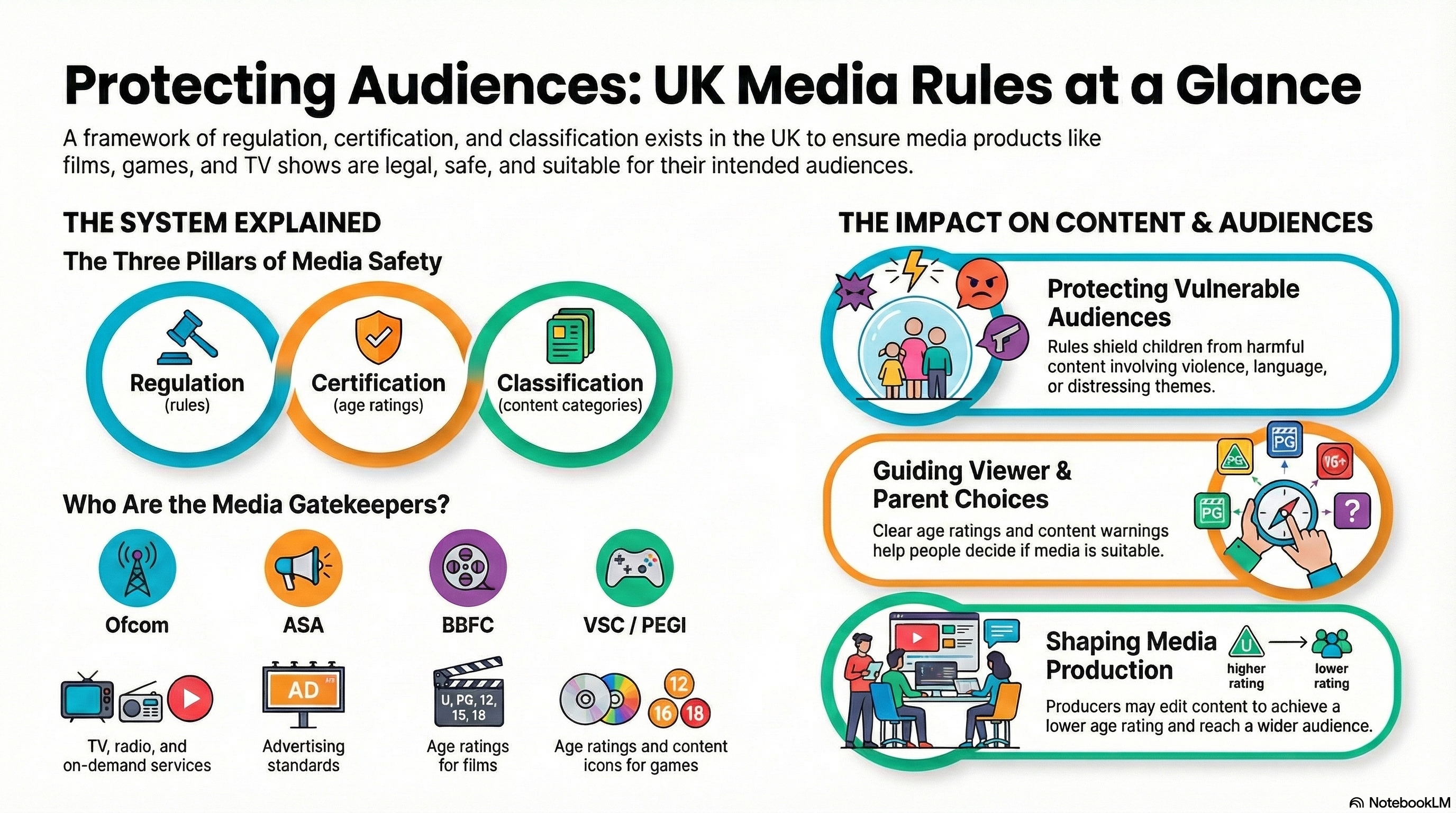
Regulation, certification and classification make sure media products are legal,
safe and suitable for their audience. Producers must follow rules and age ratings or risk
complaints, fines and content being removed.
What Are Regulation, Certification and Classification?
In R093 you need to understand how different organisations and systems control what can be shown,
who it can be shown to, and how problems are dealt with.
Regulation – rules and codes set by regulators for TV, radio, advertising and online content.
Certification – giving a certificate or age rating to a film, game or other product.
Classification – deciding which age band or content category a product belongs in.
Why It Matters
Protects audiences from harmful or unsuitable content.
Gives parents and carers clear guidance about what is appropriate.
Keeps media producers within the law and avoids complaints and sanctions.
Regulation, Certification & Classification at a Glance
These infographics summarise who regulates media products and how age ratings and content rules protect audiences.
Key UK Regulators & Rating Bodies
Organisations you must be able to name and describe in the exam.
Ofcom: regulates TV, radio and on-demand services – protects audiences from harmful or offensive content.
ASA: checks that adverts are legal, decent, honest and truthful.
BBFC: gives age ratings (U, PG, 12, 15, 18) for films and some online video.
VSC / PEGI: provides age ratings and content icons for games in the UK and Europe.
Platform policies: YouTube, TikTok and app stores have their own community guidelines.
Exam link: when given a product, state which regulator applies and why.
Rules · Ratings · Protection
How Ratings Affect Products & Exams
Using age ratings and rules in design and evaluation questions.
Suitability: make sure violence, language, sex and themes match the chosen age rating.
Target audience: rating must be realistic for the audience the client wants to reach.
Edits & cuts: producers may remove or tone down content to achieve a lower age rating.
Scheduling & access: watershed times, parental controls and store restrictions limit who can see content.
Complaints: regulators can order changes, fines or removal if rules are broken.
Exam tip: when evaluating an idea, comment on whether the content meets or breaks the relevant code or rating.
Suitability · Codes · Complaints
Regulators and Codes of Practice
Different media areas are overseen by different regulators and codes. At GCSE you
do not need legal detail, but you must know who does what and why.
Examples of Regulators and Bodies
Broadcast regulators – set rules for TV and radio content and advertising standards.
Advertising regulators – check that adverts are legal, decent, honest and truthful.
Film and video regulators – give films and some video releases an age certificate.
Games rating systems – provide age ratings and content warnings for video games.
What Regulators Look For
Harmful or offensive content (e.g. violence, discrimination, dangerous behaviour).
Protection of children and vulnerable audiences.
Accuracy, fairness and avoiding misleading content in news and advertising.
How complaints from the public are handled and resolved.
Certification and Age Ratings
Certification means officially approving a product with an age rating or
guidance label, often shown as symbols on packaging, posters or streaming services.
Why Age Ratings Are Important
Help parents and guardians decide if content is suitable for children.
Reduce the risk of young people seeing harmful or disturbing material.
Guide producers when planning content for a specific target audience.
Factors Used to Decide Ratings
Level of violence and horror.
Language – strength and frequency of bad language.
Sexual content and nudity.
Drug and alcohol use.
Whether themes are likely to be harmful or confusing to younger audiences.
Classification and Content Guidelines
Classification groups media products into categories based on their content and audience.
These categories are supported by detailed guidelines.
Classification in Exams
Be able to link content (e.g. mild threat vs strong violence) to a suitable rating.
Explain why a product might need a higher or lower rating.
Describe how classification helps protect individuals and society.
Impacts on Production
Producers may change content (e.g. reduce violence or strong language) to reach a lower age rating.
Some projects are aimed at adults and accept a higher rating to match their creative vision.
Marketing and distribution strategies are planned around the final certificate.
Use the NotebookLM for this topic to revise regulators, age ratings and classification decisions,
then test yourself with scenarios and quick-fire questions.
Games to Practise Regulation, Certification and Classification
These games help you apply legal and regulatory rules to real exam-style scenarios involving
age ratings, complaints and legal risks.
Legal & regulation
Legal Lightning Round
Fast-paced scenarios on copyright, permissions, privacy, defamation, data protection and
regulation, including age ratings and complaints.
ScenariosLegal issuesRegulation
Mega game · Health & safety
Health & Safety Gauntlet
Explore production scenarios where legal safety rules and duty of care are vital, linking
regulation to protecting individuals on set.
ScenariosRiskProtection
Mega game · Intellectual property
IPR Gauntlet
Work through copyright and licensing scenarios to keep media products legal when using
third-party content such as images, music and video.
Mega gameCopyrightLicensing
9-mark trainer
9-Mark Ninja
Build high-band 9-mark answers that discuss regulators, age ratings and classification,
and justify decisions in exam scenarios.
9 markersStructureExam technique
Exam Practice – Regulation, Certification and Classification (AI Marker)
Write your answers in the boxes below, then click Build & Copy AI Marking Prompt. Choose an AI tool and paste the prompt to get examiner-style marking and feedback.
Q1. State one reason why age ratings are used for films and games. (1 mark)
Technique: Give a clear, simple reason such as "to protect children from unsuitable content"
or "to help parents choose appropriate products".
Q2. Explain one way a regulator can protect audiences if a TV programme receives a large number of complaints. (2 marks)
Technique: Make one point about an action the regulator can take (e.g. investigation,
warning, fine or changing the schedule) and then explain the impact on the broadcaster or audience.
Example structure: "The regulator can… This helps because…"
Q3. Describe three factors that might be considered when deciding the age rating for a new action game. (3 marks)
Technique: Give three distinct factors, such as level of violence, strength of language
and how often disturbing scenes appear.
Q4. Explain two ways that aiming for a lower age rating could affect the content of a superhero film. (4 marks)
Technique: For each way, describe what might change (e.g. less graphic violence, fewer strong
swear words) and explain how this affects the target audience and box office.
Q5. A streaming platform wants to launch a new thriller series that includes scenes of violence, strong
language and tense, disturbing moments. Discuss how regulation, certification and classification should be
used to protect audiences while still allowing creative freedom. Provide justified recommendations. (9 marks)
Technique: Organise your answer into paragraphs (regulators, age ratings, content guidance
and scheduling/controls). Explain specific actions and link them clearly to protecting audiences. Finish
with a justified conclusion.
Paragraph 1: Regulation – following broadcasting or platform codes, responding to complaints.
Paragraph 2: Certification – choosing an appropriate age rating based on content.
Paragraph 3: Classification and guidance – content warnings, descriptions and trailers.