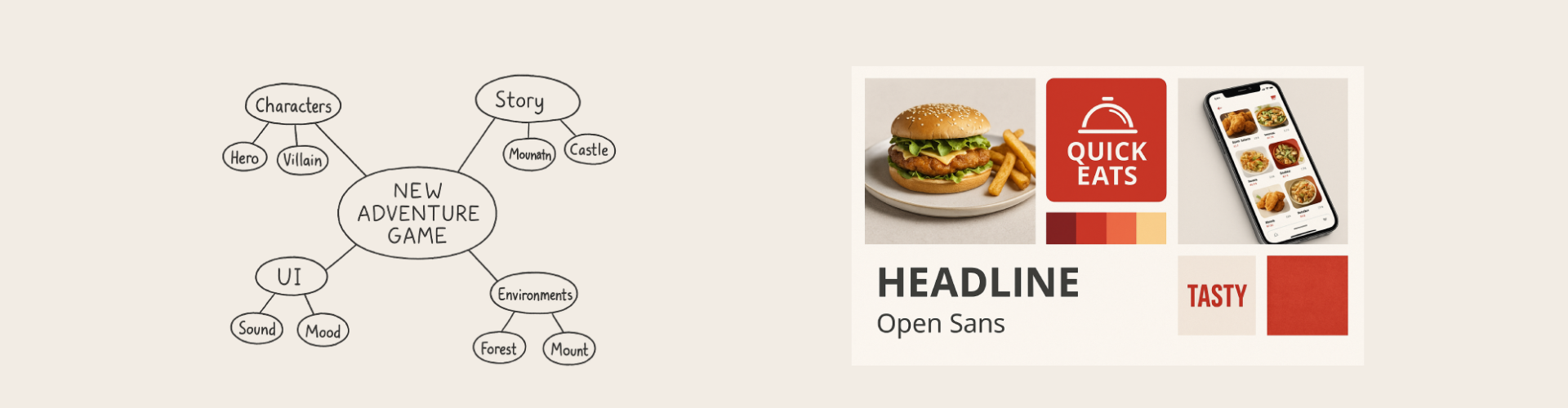
Mind maps and mood boards are early planning tools that help you explore ideas
before you commit to final designs. A strong mind map shapes your content; a strong mood board
shapes your visual style.
What Are Mind Maps and Mood Boards?
In R093 you must understand how mind maps and mood boards are used
as part of the pre-production process for media products such as websites, games, animations,
adverts and print products.
Mind maps – show ideas, topics and content linked together.
Mood boards – show the visual style using images, colours, textures and fonts.
Why They Matter
They let you experiment with ideas before you spend time on detailed documents.
They help you communicate concepts to clients or team members.
They support later documents such as work plans, scripts, storyboards and wireframes.
Mind Maps & Mood Boards at a Glance
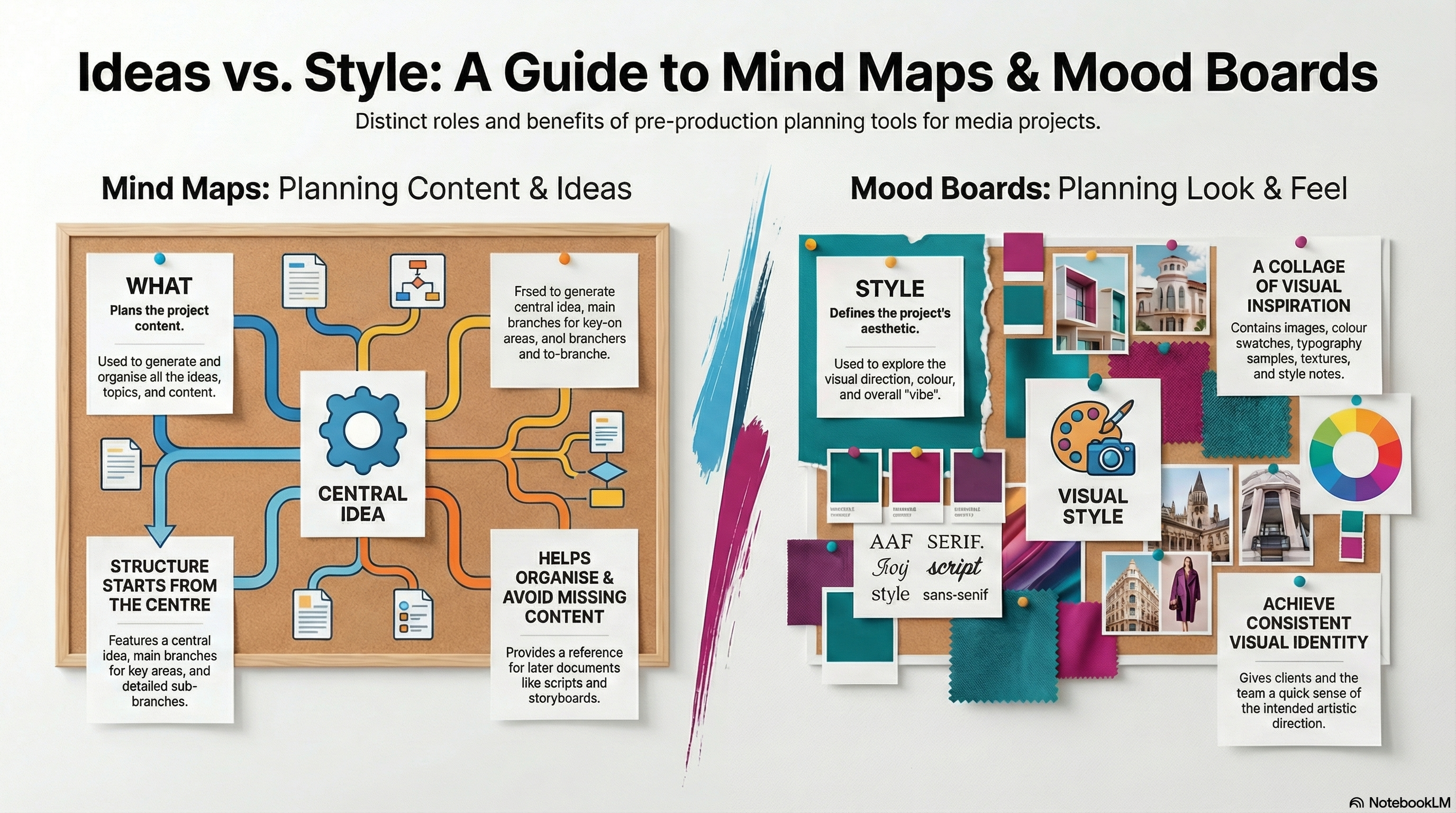
This infographic shows how mind maps and mood boards support early idea generation and visual style.
Mind Maps
Planning content, features and ideas in a structured way.
Central idea: product name, client or main theme in the centre.
Main branches: key areas such as content, features, audience, platforms.
Sub-branches: more detailed ideas, examples and possible assets.
Connections: lines and arrows to link related ideas.
Uses: to generate ideas, avoid missing content and organise structure.
Exam link: describe how a mind map helps plan what to include in a product.
Ideas · Structure · Content
Mood Boards
Exploring colour, style and atmosphere before final designs.
Images: example photos, illustrations and textures that match the brief.
Colour swatches: sample colours that could become the final palette.
Typography samples: example fonts or lettering styles.
Style notes: keywords describing the look and feel (e.g. bold, playful, minimalist).
Uses: to agree a visual direction with the client and team.
Exam tip: when explaining, link the mood board back to brand identity and target audience.
Style · Palette · Inspiration
Mind Maps – Planning Content and Ideas
A mind map starts with a central idea and branches out into related topics and sub-topics.
It is used to plan what content will go into your media product.
Key Features of a Mind Map
Central node – the main topic or project name.
Main branches – key areas such as audience, content, style, platforms and resources.
Sub-branches – detailed ideas, features or examples.
Keywords – short phrases rather than long sentences.
Colour and grouping – similar ideas grouped and sometimes colour-coded.
How Mind Maps Help
Generate lots of ideas quickly.
Show links between different aspects of the project.
Highlight gaps where more research or ideas are needed.
Provide a reference when creating scripts, storyboards and work plans.
Exam Tips for Mind Maps
Be ready to identify weaknesses in a poor mind map (e.g. no audience branch, too few ideas).
Be prepared to suggest improvements (add branches, sub-branches, annotations, colour-coding).
Use the term "pre-production document" and link your points to the project brief.
Mood Boards – Planning Look and Feel
A mood board sets out the visual style of a project using reference images,
colours, textures and type examples. It gives a quick impression of the overall "vibe" of
the product.
Use the NotebookLM for this topic to review examples of good and weak mind maps and mood boards,
and test your understanding of how they are used in projects.
These games help you spot strong and weak planning documents, improve mind maps and connect
early ideas to later stages of the project.
Pre-production
Mind Map Makeover
Fix broken mind maps by adding missing branches, grouping related ideas and improving annotations,
so they are useful for later planning documents.
9 markersMind mapsImprovements
Pre-production
Document Doctor
Decide when to use mind maps, mood boards, scripts, storyboards and other planning documents
for different project briefs.
MCQsPlanning docsComponents
Pre-production
Pre-Production Race
Place planning documents, including mind maps and mood boards, into the correct phase and make
sure they appear at the right time in the project.
Short answersWorkflowsPhases
9-mark trainer
9-Mark Ninja
Practise writing high-band 9-mark answers that justify why strong mind maps and mood boards
are important at the start of a media project.
9 markersStructurePlanning
9-mark trainer
9-Mark AI Trainer
Write a full 9-mark answer using real R093-style scenarios, then generate an AI marking prompt to get a score and feedback.
9 markersFull answersAI feedback
Mind maps & docs
Pre‑Production Toolkit
Choose the correct pre-production document for each scenario: work plans, mind maps, scripts, storyboards and more.
Arcade quizPre‑productionDocuments
Exam Practice – Mind Maps and Mood Boards (AI Marker)
Write your answers in the boxes below, then click Build & Copy AI Marking Prompt. Choose an AI tool and paste the prompt to get examiner-style marking and feedback.
Q1. State one purpose of a mind map in the planning of a media product. (1 mark)
Technique: Give a clear purpose such as "to generate and organise ideas"
or "to identify different content areas".
Q2. Explain one reason why a designer creates a mood board before designing a website. (2 marks)
Technique: Make one point about how a mood board helps (e.g. choosing colours and style)
and then explain the impact on the final design or client.
Example structure: "A mood board is used to… This helps because…"
Q3. Describe three elements you would expect to see on a mood board for a horror film poster. (3 marks)
Technique: Give three distinct elements (e.g. dark colour palette, example fonts,
reference images) and keep each idea short and clear.
Q4. Explain two ways a weak mind map could cause problems later in a media project. (4 marks)
Technique: For each way, describe the weakness (e.g. missing audience branch,
very few ideas) and explain how this might affect later documents or the final product.
Q5. A small business wants to create a new interactive brochure website. Discuss how effective use of mind maps
and mood boards at the start of the project could help produce a successful final product. Provide justified
recommendations. (9 marks)
Technique: Structure your answer into clear paragraphs for mind maps and mood boards.
Explain how each tool will support audience understanding, content planning and visual consistency, then
end with a justified conclusion.
Paragraph 1: Mind maps – planning content, navigation and features.